The Clock Doesn't Care If You're Nice: Blood of the Dawnwalker and the Practice of Disappointing People


The Approval We Perform
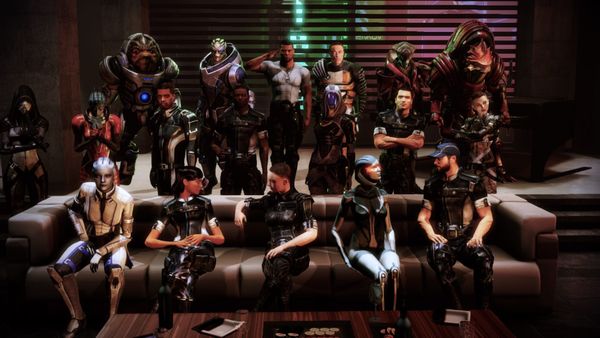
I have never completed a Renegade playthrough of the Mass Effect Trilogy. I have tried, more times than I can recall, and every time I abandoned the run somewhere in the first hours of gameplay, overwhelmed by the weight of being disliked, of being "mean." I have also never played a Low Honor Arthur Morgan in RDR2. The thought of it makes my chest tighten. In any game that tracks morality, affection, or faction approval, I instinctively drift toward the maximum. I rescue every damsel in distress, return every lost item, and analyze every dialogue tree to make sure what I choose to say won't make anyone angry with me.
For a long time, I thought this was just a preference. Cozy gameplay, no harm done. But the pattern is too consistent to be casual. It matches the pattern I carry everywhere else: the belief that if I can just be good enough, accommodating enough, and helpful enough, I will finally be safe from rejection. That if I perform worthiness perfectly, love will be guaranteed. This is a parental wound dressed up as a playstyle. We play the way we were raised to survive.
Clinically, this pattern lives in the territory of attachment and trauma. When a child learns that love is conditional on compliance–that safety is withdrawn when they are inconvenient, disappointing, or angry–they internalize a model of relationships as transactional. The child does not become kind because kindness is freely given. They become kind because kindness is currency. The good ending, in the game and in the mind, is not a moral achievement, it's a survival strategy.
A Time System That Doesn't Negotiate
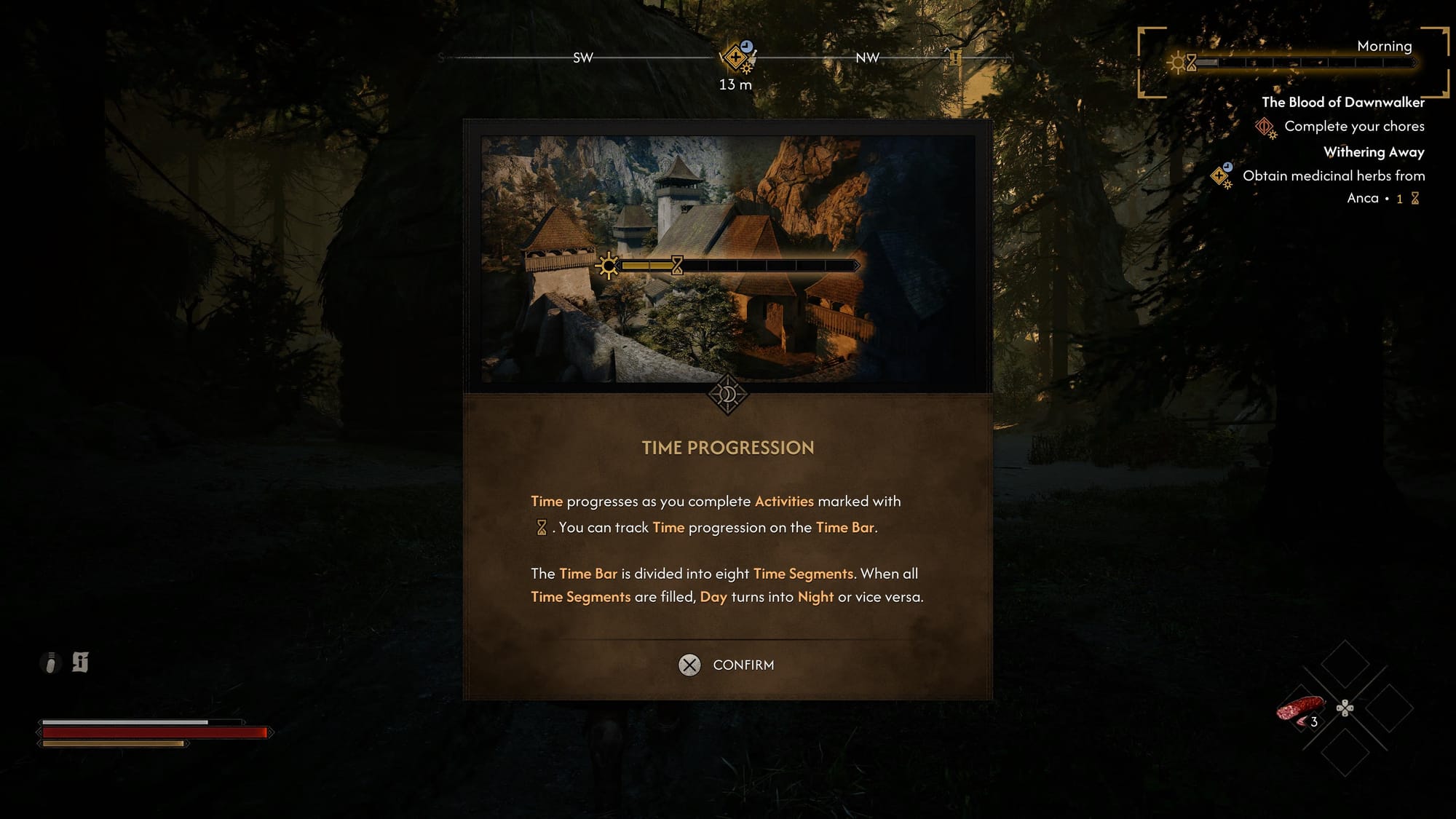
Blood of the Dawnwalker does not run on a ticking clock. The world does not punish you for standing still. Instead, it gives you a limited number of time segments–a finite budget you spend like currency. Every side quest, every favor asked, every wandering NPC with a problem costs one or more of those chunks. If you spend your budget on what you merely want to do, you may not have enough left for what you need to do. The game does not reward completionism. It punishes it. To save one person is, often, to let another down. There is no secret route that allows you to do everything. The architecture of the world insists that you choose, and that the choice will cost you something.
For many of us who approach games with this mindset, this seems like a cruel mechanic, when in reality, it's just an honest one. Most RPGs let us live in the fantasy that with enough effort, we can satisfy everyone. Dawnwalker removes that fantasy. It forces the player into the exact position that people-pleasers spend a lifetime avoiding: the position of having to say no, having to disappoint someone, having to live with the discomfort of knowing you were not, in this moment, the kind person you want to believe you are.
The Grandmother and the Cross
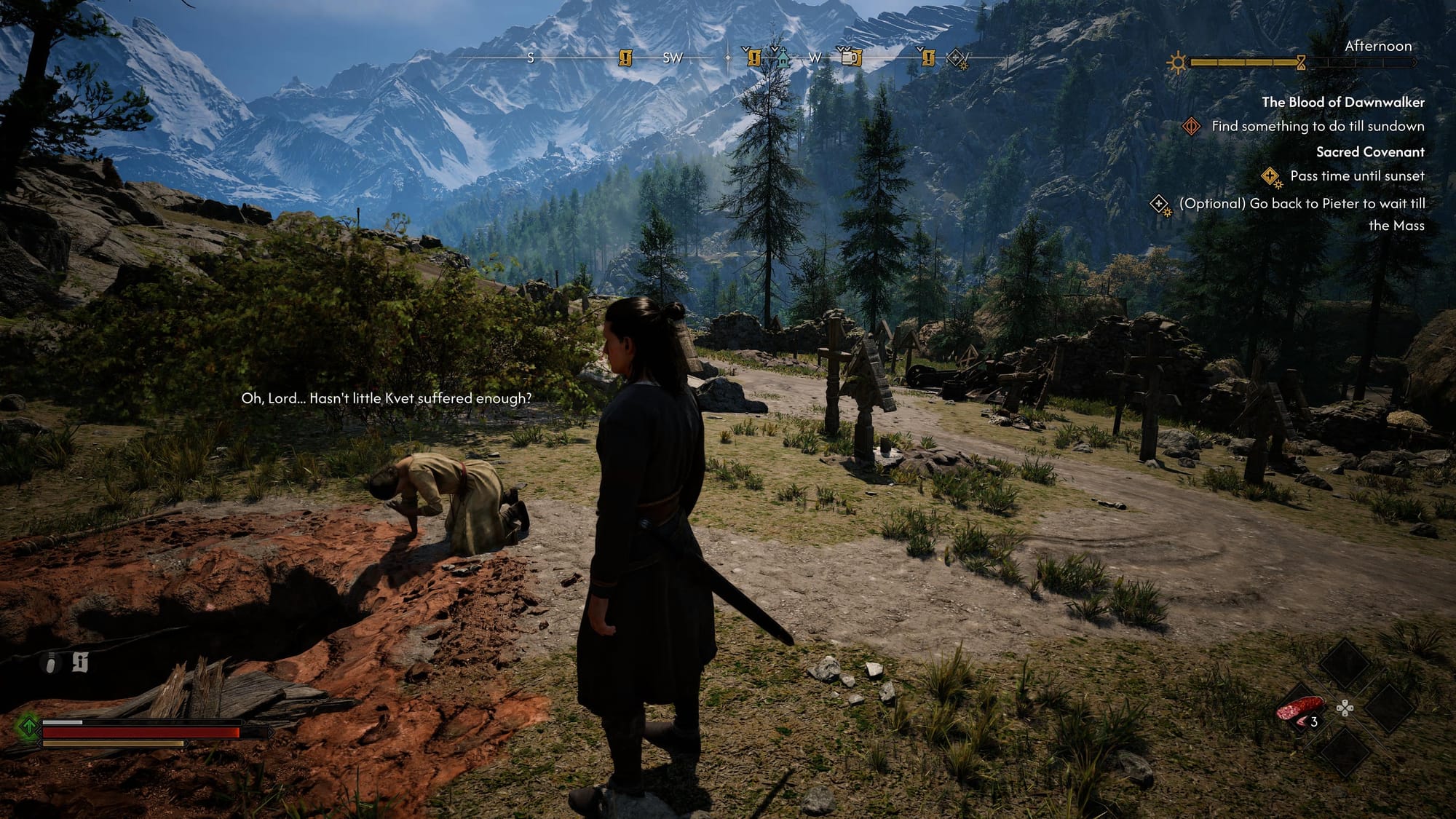
The moment that broke me open happened early in the game. I was trying to save my character's mother, carefully rationing my time chunks, when I came across an old woman kneeling over an opened grave. Her grandson had died, and someone had dug him up. The grave robber had stolen the silver cross she had buried him with. She looked up at me and asked me to find it.
I did. I tracked the thief down, recovered the cross, and brought it back to her. It cost me one of my eight allotted time chunks, but it felt right. This is what I do. Someone is hurt, and I fix it. That is the identity I have built my life around.
When I returned, she was still kneeling at the grave. She held the cross in her arthritic hands and asked me to help her rebury him. She could not do it herself. Her hands were too old, too stiff. She needed someone to dig, to lift, to place him back in the earth with the cross restored. It was a small, human request. Under any other circumstances, I would have said yes immediately, because that is the reflex: the task is unfinished, and I am someone who finishes things. I am someone who does not leave a grieving grandmother alone at an open grave.
But I looked at my remaining time. I looked at all the other things I had yet to do. I looked at the cost. And I told her no. I said I could not help her rebury her grandson. It would cost another chunk I could not afford to spend. I watched the dialogue close, and I felt it immediately: that sick, hollow drop in the pit of the stomach, the ick that comes when you have just done something that violates your own self-image. I had helped her, but I had not helped her enough. I had done the heroic part, and then abandoned her at the manual, human labor of grief.
I wanted to reload. I wanted to go back and say yes, consequences be damned, just to make the feeling stop. But I didn't. I kept moving. And the game continued.
The Discomfort Is the Point
For most of my life, I have treated that stomach-drop feeling as a signal that I have done something wrong. If it feels bad, I must have made a mistake. But in Dawnwalker, the ick is not an error. The game is not asking you to be cruel. It is asking you to tolerate the discomfort of being insufficient to every demand. It is asking you to survive the feeling of someone being disappointed in you and discover that the world keeps turning anyway.
In Acceptance and Commitment Therapy, this is called experiential avoidance: the reflexive effort to control or escape unpleasant internal experiences–guilt, shame, the unease–even when that avoidance pulls us away from our values. The people-pleaser does not say yes because they genuinely want to help. They say yes because the alternative–feeling like a bad person–is intolerable. The avoidance becomes so automatic that the person never learns whether the feeling itself is survivable. Dawnwalker does not let you avoid it. It makes the guilt mandatory and then demonstrates, by continuing to run, that the feeling is not fatal.
Fawning Wears a Hero's Cape
Pete Walker, in his work on complex trauma, identifies fawning as the fourth survival response alongside fight, flight, and freeze. Fawning is the strategic abandonment of self in order to appease a perceived threat. It is the child who learns to read the room before they read their own body. The adult who scans for what others need before they ask what they need. It is the player who chooses every Paragon option not because they believe in it, but because the disapproval of a fictional companion triggers the same neurological alarm as real-world rejection.
The fawn response is not kindness. Kindness is chosen. Fawning is compulsive. It happens faster than thought because it is stored in the autonomic nervous system as a survival protocol. In the game world, where the stakes are fictional, this distinction becomes visible. You can see the compulsion operating in a space where there is no actual danger. The companion who dislikes you cannot hurt you. The NPC who dies because you were not there is code. But the alarm is real. The body does not know the difference between a disapproving NPC and a disapproving parent. It only knows that disapproval is unsafe, and it deploys the fawn response accordingly.
Dawnwalker's time system interrupts this protocol. It does not care about your fawn response. It presents a world where the fawn response is mathematically insufficient. You cannot appease everyone because you do not have enough time chunks to do so. The game does not punish you for trying. It simply makes the failure state visible. You run out of segments. You do not save your mother. The fail state is not a judgment of your morality, but a consequence of your limitation. And limitation is the thing the fawn response was built to conceal.
Where Games Usually Reward Our Wound
Most games do not challenge this pattern. They feed it. Companions like you more when you agree with them. You get the good ending when you help everyone. The morality meter rewards you for being the best, kindest, most accommodating version of yourself. These systems reinforce the same belief we learned early: that there is a perfect performance of goodness that will unlock safety and love, and that any deviation from that performance is a failure.
Dawnwalker refuses to participate in this economy. It is not interested in your perfect score. It presents a world where goodness is not a matter of thoroughness but of triage. You cannot be the hero of every story. You cannot be the favorite child of every NPC. The time budget makes that mathematically impossible, which means the game is not testing your morality. It is testing your tolerance for reality.
Rehearsing the No
In therapy, we often talk about boundaries as if they are intellectual decisions. We script them, we practice them in session, we analyze the interpersonal dynamics that make them difficult. But intellectual understanding rarely reaches the body in time. The reflex to please is faster than thought. It is stored in the nervous system as a survival response, not a rational choice.
What makes Dawnwalker clinically interesting is that it bypasses the intellect and goes straight to the body. You are not reading about boundaries. You are performing them in a contained environment where the stakes are real enough to trigger the discomfort but not so real that you will actually lose a relationship or a job. You bring the grandmother her cross. Your stomach drops when you say no to the rest. The game continues. You survive the moment. And then you do it again, somewhere else, with another NPC, under another budget constraint, until the sensation begins to lose its catastrophic charge.
This is exposure and habituation wearing a narrative mask. In prolonged exposure therapy for trauma, the client is asked to approach the feared stimulus repeatedly, without avoidance, until the nervous system learns that the stimulus is not dangerous. Dawnwalker offers a version of this process: the feared stimulus is not a traumatic memory but the experience of being a disappointing person. The player approaches it repeatedly, makes the choice, feels the guilt, and discovers that the game state does not collapse. The grandmother remains sad. The mother is saved. The player survives. With repetition, the alarm response begins to habituate. The player learns, in their body, that disappointing someone is not the same as dying.
The game is not asking you to be a terrible person. It is asking you to discover that being a limited person is survivable.

The Skills Playground
One of the core ideas I had in mind when I started this Game World Therapy project is that games do not just illustrate psychological concepts. They let us inhabit them. We can read about boundaries in a workbook, but we cannot feel them until we practice them in a context where someone else's disappointment is registered, processed, and survived. Dawnwalker provides that context with remarkable efficiency. It does not ask you to roleplay a boundary in a therapy office. It presents you with a living choice, an emotional consequence, and a world that continues to function after you have made the "wrong" choice by your own standards.
For people who learned early that love was conditional on compliance, that discovery is not small. It is the difference between a life organized around the prevention of disapproval and a life organized around the tolerability of it. The game does not promise you will feel good about your choices. It only promises that you will survive them. That is, for some of us, exactly the rehearsal we need.
The Dawn Comes Anyway
I still have not done a Renegade playthrough in Mass Effect. I do not know if I ever will. But I am learning, in Dawnwalker, that I can make a choice that makes me feel like an unkind person and still be allowed to keep playing. The grandmother is still kneeling at that open grave in my memory. I still feel the ick when I think about her arthritic hands and the cross I returned but could not place. But I also saved my character's mother, and the story continued, and the dawn arrived on schedule, indifferent to whether I had been nice enough to deserve it.
That indifference is the lesson. The world does not require your perfection to keep turning. You are allowed to be limited. You are allowed to disappoint people. You are allowed to feel discomfort and do the necessary thing anyway. The sun will not withhold itself for your guilt, which means, eventually, you might stop withholding yourself for it too.