Returning to Grace: How Elden Ring Teaches the Nervous System to Resource


Elden Ring is a 2022 action RPG developed by FromSoftware, set in a vast open world called the Lands Between. The player takes the role of a "Tarnished"—an exiled figure called back to a broken land to restore something that has been shattered. The game is renowned for its difficulty; combat is precise, punishing, and demands patience. When the player dies—and they will, often—they respawn at checkpoints called Sites of Grace, losing their accumulated currency (runes) unless they can retrieve it from the site of their death. There are no difficulty settings, minimal instructions, and no single correct path through the world. The player decides where to go, what to fight, and when to walk away.
I have insisted, loudly and to anyone who would listen, that I hate these games.
Since the first Dark Souls carved out its niche in 2011, the Souls-like genre has built a devoted following around punishing difficulty, cryptic design, and the particular satisfaction of overcoming something that felt impossible. I understood the appeal intellectually. I wanted no part of it personally. I don't enjoy feeling incompetent. I don't want to be punished by a game in my leisure time. I don't find repeated failure motivating. I watched friends describe their hard-won victories with a fervor I associated more with religious conversion than recreation, and I smiled and nodded and kept playing games that didn't make me want to break my controller.
Then I built a client's treatment plan around Elden Ring.
The clinical rationale, which I'll detail below, was sound, but it meant I needed to understand the game from the inside, not from secondhand descriptions and YouTube boss guides. So I started playing. I died. Constantly. I died in ways that felt personally insulting. I died because I got overconfident. I died because I turned my head for a second to look at my dog. I died to enemies I could see coming and still couldn't avoid. I died to the tutorial boss, which I later learned was supposed to kill me, though that knowledge did not arrive in time to prevent the shame.
And then, somewhere around the thirtieth attempt at a fight I'd convinced myself was impossible, something shifted. Not the game. Me. I read the boss's pattern one half-second earlier than I had before. I dodged when I'd been blocking. I used a flask at the right moment instead of panic-healing into another hit. And when the victory screen appeared, I understood—in my body, not just my mind—what every person who loves this genre has been trying to describe to me for over a decade.
That experience is where this piece begins.
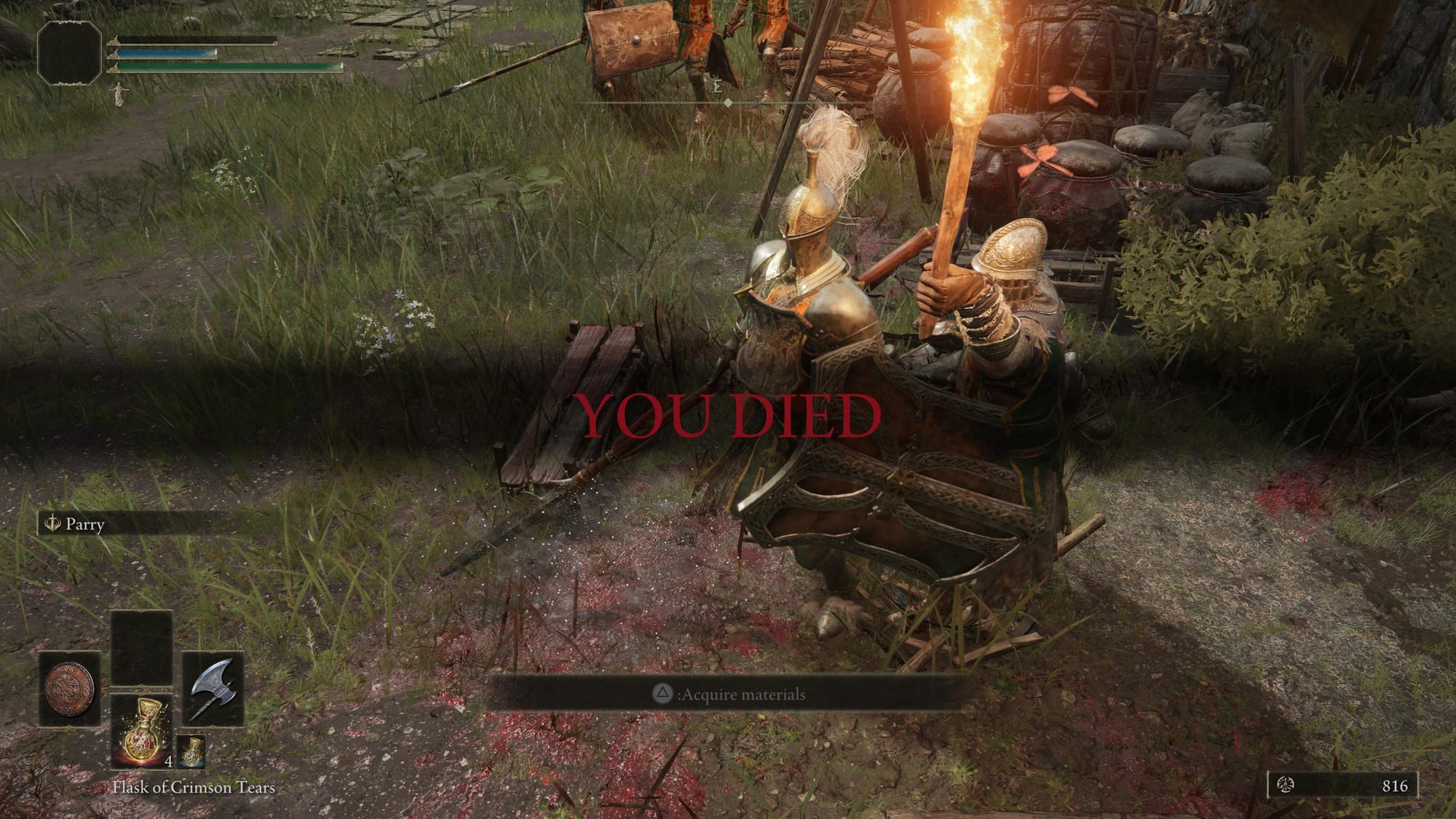
You die. The screen goes dark, two words appear, and the world resets.
You know the rhythm by now. The tightening in your chest as the boss charges. The frantic dodge that comes half a second late. Your health bar empties in a single hit you saw coming and couldn't stop. Then silence. A loading screen. The glow of the last Site of Grace you rested at, waiting for you like it always does.
The urge to quit is immediate and physical. You want to put the controller down — or possibly throw it across the room. Your jaw aches from clenching. You think this isn't worth it—but then you think, try again.
That tension—between overwhelm and return—is not incidental to Elden Ring's design. It is the design. And it mirrors a process that trauma therapists spend months trying to teach: how to get overwhelmed, how to come back, and how to trust that coming back is possible.
This isn't a metaphor you have to squint to see. Elden Ring is, mechanically and structurally, a practice ground for the skill clinicians call resourcing.
What Is Resourcing?
In trauma-informed clinical work, resourcing refers to the deliberate cultivation of internal and external anchors that help a person regulate their nervous system during or after activation. It's one of the foundational skills in stabilization-phase trauma treatment.
Internal resources include breath awareness, grounding self-talk, calming imagery, and access to memories of safety or competence. External resources include the physical environment, supportive relationships, sensory objects, and structured routines that signal safety to the body.
The purpose of resourcing isn't to eliminate distress. It is to expand what clinicians call the window of tolerance—the range of emotional and physiological activation a person can experience while still maintaining the capacity to think, feel, and choose. When activation exceeds that window, the system shifts into hyperarousal (fight, flight, panic) or hypoarousal (freeze, collapse, dissociation). Resourcing creates return points: places—internal or external—where the nervous system can recalibrate after being pushed past its edge.
What matters here, and what will matter when we get to how Elden Ring actually functions, is that resourcing is not purely cognitive. You cannot think your way into nervous system regulation. The body has to learn it is safe through repeated experience, not just through understanding. Bottom-up processing—the kind that builds through physical repetition, sensory familiarity, and practiced return—creates a form of knowledge that insight alone cannot replicate.
Elden Ring cycles players through activation and recovery hundreds of times. That repetition isn't a side effect of the game's difficulty. It's the point.
Why Elden Ring?
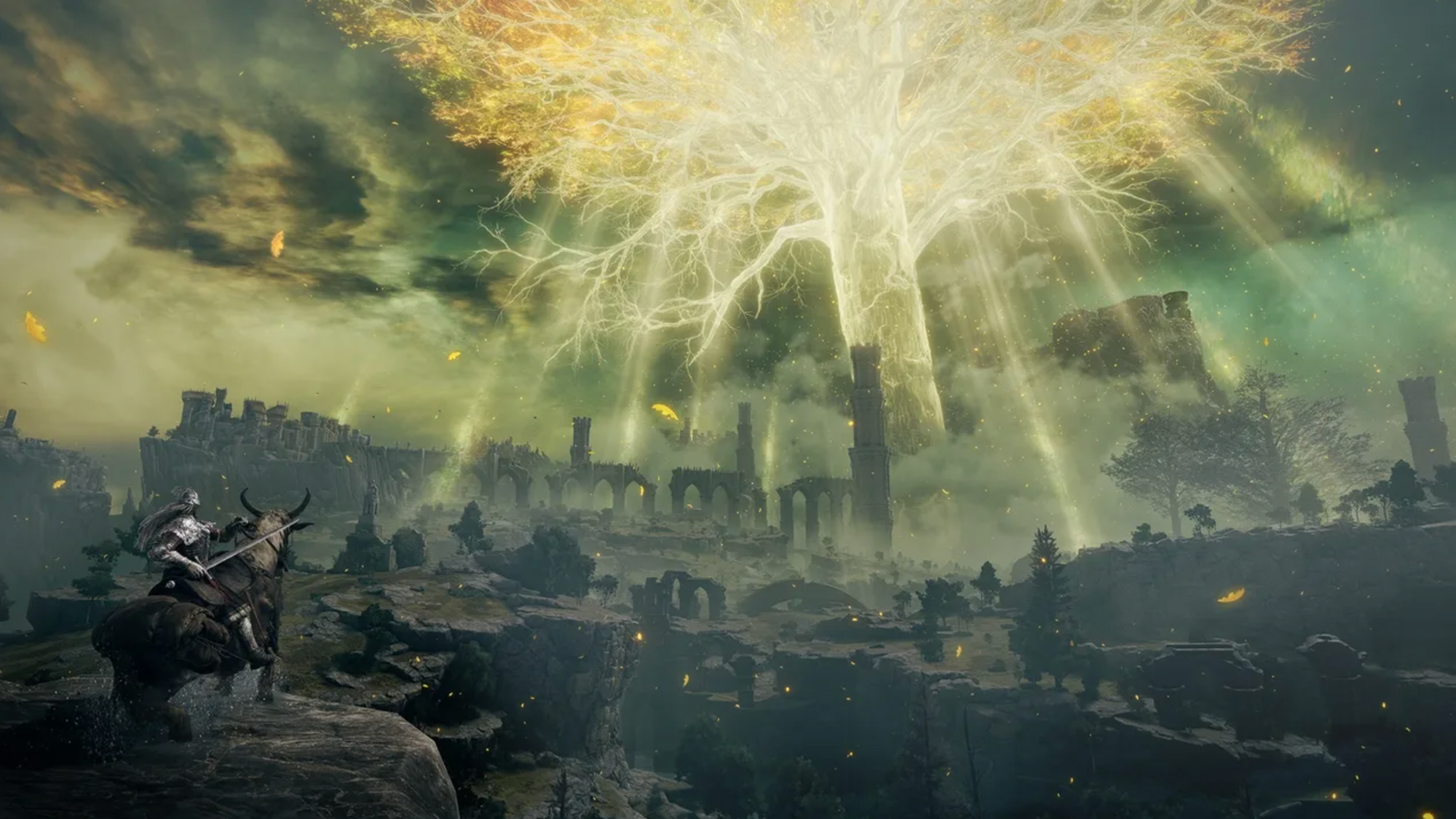
The obvious objection: couldn't any hard game do this?
Not quite. Difficulty alone is not what makes a game clinically interesting. What matters is how the difficulty is structured—what the game does with failure, how it frames the player's relationship to challenge, and how much agency it offers in determining the pace and sequence of engagement.
Elden Ring does several things that set it apart from other demanding games:
Death is a mechanic, not a punishment. The game expects you to die. Repeatedly. Death is woven into the progression loop—it provides information, resets the encounter, and returns you to your last point of safety. The system treats failure as data, not as a verdict on the player's competence. This is a fundamentally different relationship to failure than games where death carries heavy penalties, narrative consequences, or shame-laden framing.
The world does not explain itself. There is no quest log telling you where to go next, no difficulty rating on boss doors, no tutorial that walks you through every mechanic. You develop your own understanding through exploration, experimentation, and pattern recognition. Over time, this builds internal authority—the player's sense that they can navigate ambiguity without external validation. In clinical terms, this fosters an internal locus of evaluation rather than dependence on external scaffolding.
Activation and recovery are structurally enforced. Death always returns you to the last Site of Grace. You cannot checkpoint mid-fight or resume from the moment things went wrong. The game exists in a cycle of stress and regulation—every death requires the player to move through recovery before re-engaging, ensuring that the return to safety is not optional or skippable but a required part of forward movement.
The open world allows genuine pacing choice. This is the critical difference between Elden Ring and its predecessors. In Dark Souls, progression is largely linear—you face the next challenge or you stop playing. In Elden Ring, you can leave. You can walk away from a boss, explore a different region, build your character's capacity in lower-stakes areas, and return when you're ready. The game never forces you into the next hard thing. That choice—to engage with difficulty on your own terms rather than being funneled into it—mirrors the non-linear, client-paced nature of trauma work far more directly than any corridor-based design can.
Other difficult games share overlapping therapeutic value. Celeste engages directly with anxiety and self-compassion through both narrative and mechanics. Dark Souls teaches persistence and pattern recognition. But Elden Ring's open-world structure is what most closely maps to the way trauma recovery actually unfolds: non-linearly, at the client's pace, with the freedom to retreat and return as capacity allows.
The Lands Between as a Nervous System Landscape
The world of Elden Ring is not uniformly dangerous. Its regions vary dramatically in intensity, predictability, and the type of attention they demand—and that variation maps onto the states of nervous system arousal that trauma clinicians work with daily.
Overwhelm zones exist throughout the game. Caelid, the scarlet-rotted wasteland, assaults the player with hostile enemies, disorienting terrain, and an aesthetic of decay that creates an ambient sense of wrongness before anything attacks. Boss arenas compress the world into a sealed room with a single threat that demands total focus. Unexpected ambushes—enemies hidden behind corners, mimics disguised as treasure—trigger the startle response time and again.
Invasions deserve attention here too. In Elden Ring's multiplayer, other players can invade your world without warning or consent. There is no opt-out while you are engaged in cooperative play. An invasion arrives as an unpredictable, uninvited threat that disrupts whatever you were doing and forces an immediate response. The parallel to trauma triggers is direct: an intrusion you did not choose, arriving on someone else's timeline, demanding that you respond with whatever resources you have available in that moment. You can't prevent it. You can only work with what happens next.
Neutral and exploration zones offer a different register. Early Limgrave—open fields, scattered ruins, low-level enemies that telegraph their attacks—provides space for curiosity without constant threat. These areas allow the player to practice movement, test abilities, and build familiarity with the world at a pace that doesn't overwhelm. They are the equivalent of the regulated middle ground within the window of tolerance: activated enough to be alert, not so activated that executive function shuts down.
Safety zones are explicit. The Roundtable Hold exists outside the game world entirely—a social space where no combat occurs, where NPCs offer conversation and services, where the player can organize their inventory and make decisions without time pressure. Sites of Grace, scattered throughout every region, function as reliable points of pause: heal, level up, reorient, choose a direction.
What emerges from this is a map that mirrors states of arousal. Hyperarousal—boss fights, invasions, Caelid—pushes the system past its tolerance threshold. Hypoarousal—aimless wandering, disengagement, the flat affect of a player who has stopped caring about outcomes—represents the collapse response. Regulation lives in the deliberate movement between zones: resting, preparing, choosing when to engage and when to pull back.
The Lands Between, read this way, is more than just a setting. It's the nervous system rendered in a video game.
Sites of Grace as Externalized Resourcing
Every Site of Grace in Elden Ring does three things. It restores health—a physiological reset. It provides directional guidance—a faint golden trail pointing toward the next objective, offering orientation without dictation. And it offers pause—a moment of containment where the player can stop, assess, and prepare without the pressure of ongoing threat.
These three functions correspond to what effective resourcing provides in clinical work: physiological stabilization, a sense of orientation within one's experience, and a container that holds the person while they gather themselves.
The deeper therapeutic parallel is in what Sites of Grace represent about the relationship between the player and difficulty. Resourcing is not winning the fight. It is returning to a place where the fight becomes survivable. The Site of Grace doesn't remove the boss. It doesn't lower the difficulty. It doesn't guarantee success. What it does is restore the player's capacity to engage again—rested, healed, and with the option to try a different approach.
This reframe matters clinically. Clients in trauma recovery often equate progress with the ability to endure without breaking. But the skill isn't endurance. The skill is return. You're allowed to leave the boss fight. You're allowed to reset. You're allowed to come back with a different weapon, a different strategy, a different level of preparation. The grace point doesn't judge how many times you need it.
Death Without Catastrophe
The words YOU DIED appear in Elden Ring with the regularity of progress notes. They are expected, not exceptional. The game's entire learning model is built on the assumption that death will happen—frequently—and that what the player does after death is where growth occurs.
In trauma-informed work, this reframe is essential. Activation does not equal regression. Getting overwhelmed does not erase progress. What looks like failure—a flashback, a shutdown, a moment where the coping skills didn't hold—is often the system encountering its current edge. "You died" becomes: you got dysregulated. You exceeded your capacity in that moment. You now have new information about where your edge is and what pushed you past it.
The fear of losing runes sharpens this parallel. When you die in Elden Ring, you drop your accumulated runes—the game's currency for growth—at the point of death. You get one chance to retrieve them. Die again before reaching them, and they're gone permanently.
That anxiety—the dread of losing what you've built—maps onto a real clinical barrier. Clients frequently interpret post-session difficulty as evidence that therapy is making things worse. A hard session followed by a rough week can feel like proof of lost ground, and the fear of that loss becomes its own obstacle to engagement. The rune-loss mechanic externalizes this fear in a space where it can be experienced, tolerated, and survived. Sometimes you get your runes back. Sometimes you don't. Either way, you continue.
And here the game reveals something it has been teaching all along: frustration tolerance is not a byproduct of Elden Ring's difficulty. It's the central clinical target.
The moment you want to quit—the white-hot impulse to put down the controller after the fifth death to the same boss—is the window of tolerance being exceeded. That moment holds information. It tells you where your edge is, what kind of activation pushed you past it, and what your default response looks like when you get there. Do you rage? Withdraw? Dissociate? Try the same approach harder, faster, angrier?
The parallel to DBT's distress tolerance framework is direct. The skill is not eliminating the discomfort, it's tolerating it without acting destructively on it—without smashing the controller, without quitting the game, without concluding that you are fundamentally incapable. Returning to the fog gate after dying is a practiced act of distress tolerance. Each return says: I can feel this frustration and still choose to engage. That is not stubbornness. It's rehearsal.
Part two of this series will explore how Elden Ring's mechanics translate into practical resourcing skills—flask management as energy pacing, spirit summons as co-regulation, titration through boss encounters—and where the framework reaches its clinical limits.