The Class You Choose When You're Hurting: What Your Diablo IV Main Reveals About How You Cope

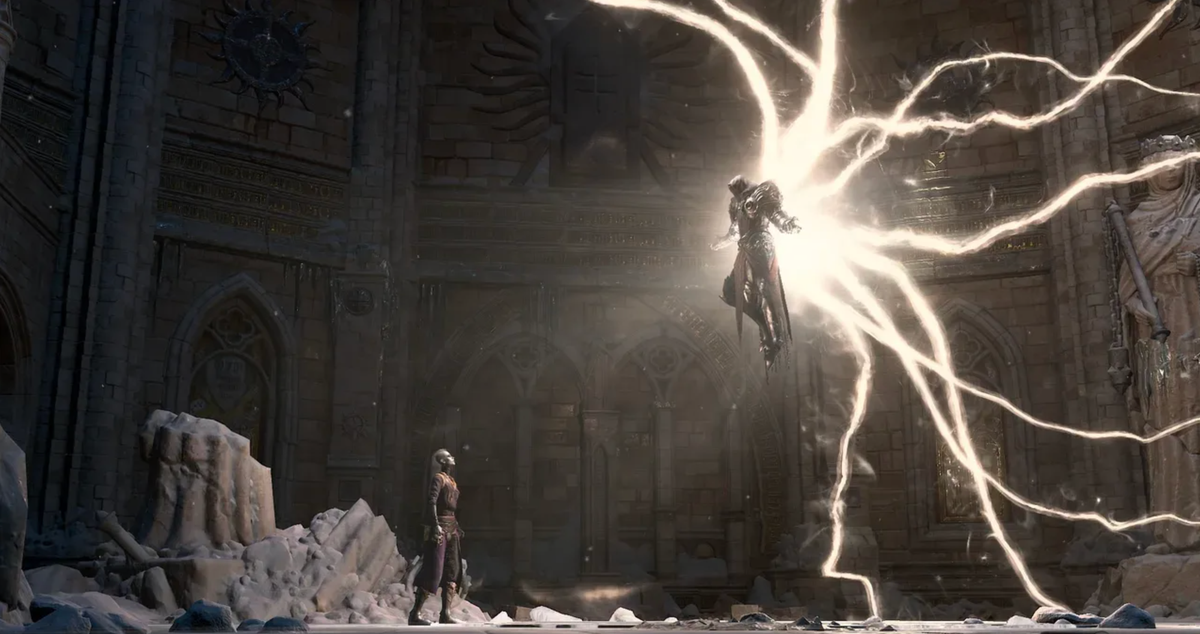
The class you pick when everything is fine is fantasy fun. The class you pick when you're struggling might speak to your coping style.
The Selection Screen
You know the moment. Something has happened—a bad day, a grief wave, a conversation that left your chest tight and your thoughts loud. You don't want to talk about it. You don't want to sit with it. You open Diablo IV, and the character select screen appears.
Seven classes. Seven different ways to move through a world full of demons that need killing.
You pick one. Maybe it's the one you always pick. Maybe it's one you haven't touched in weeks. Either way, the choice isn't random. It feels like reaching for a specific tool in a drawer—not because you've consciously diagnosed the problem, but because your hand knows what it needs before your mind catches up.
What you reach for–and when–contains information.
A Quick Word on Regulation
Before we look at the classes, it helps to understand what the nervous system is actually doing when you sit down to play.
The autonomic nervous system has one central job: manage your state. It moves you along a continuum between sympathetic activation (the fight-or-flight response—heart rate up, muscles tense, attention narrowed to threat) and parasympathetic rest (the recovery state—heart rate down, digestion active, the body signaling that it's safe to stand down). These aren't switches that flip cleanly. They're dials, constantly adjusting based on what the brain predicts the environment will demand next.
Lisa Feldman Barrett's research on how the brain constructs emotion offers a useful frame here. The brain isn't passively reacting to the world. It's running predictions—constantly generating guesses about what's happening and what will happen next, based on prior experience. When those predictions are shaped by trauma, chronic stress, or grief, the brain may consistently predict threat even in safe environments. The body responds accordingly: activation that doesn't match the moment, vigilance that won't stand down, a system that feels stuck.
Dan Siegel's window of tolerance model describes the range of arousal within which a person can function effectively—alert enough to engage, calm enough to think, flexible enough to shift between the two. Inside the window, you can respond to challenges without becoming overwhelmed. Outside it, you're either in hyperarousal (anxious, reactive, flooded, unable to slow down) or hypoarousal (numb, flat, disconnected, unable to mobilize).
Trauma, chronic stress, grief, and sensory overwhelm can all narrow this window. When you're outside it, your system looks for ways back in. Sometimes it needs to discharge energy. Sometimes it needs to impose order. Sometimes it needs distance, or purpose, or the experience of power in a context where power feels safe.
Diablo IV offers all of these, distributed across its classes. Each class is a different regulatory instrument. The one you reach for under stress may reflect not just what you enjoy, but what your mind is asking for.
The Archetypes
These aren't diagnoses. They're patterns—ways of engaging a game that echo how we engage distress when the body is running the show.
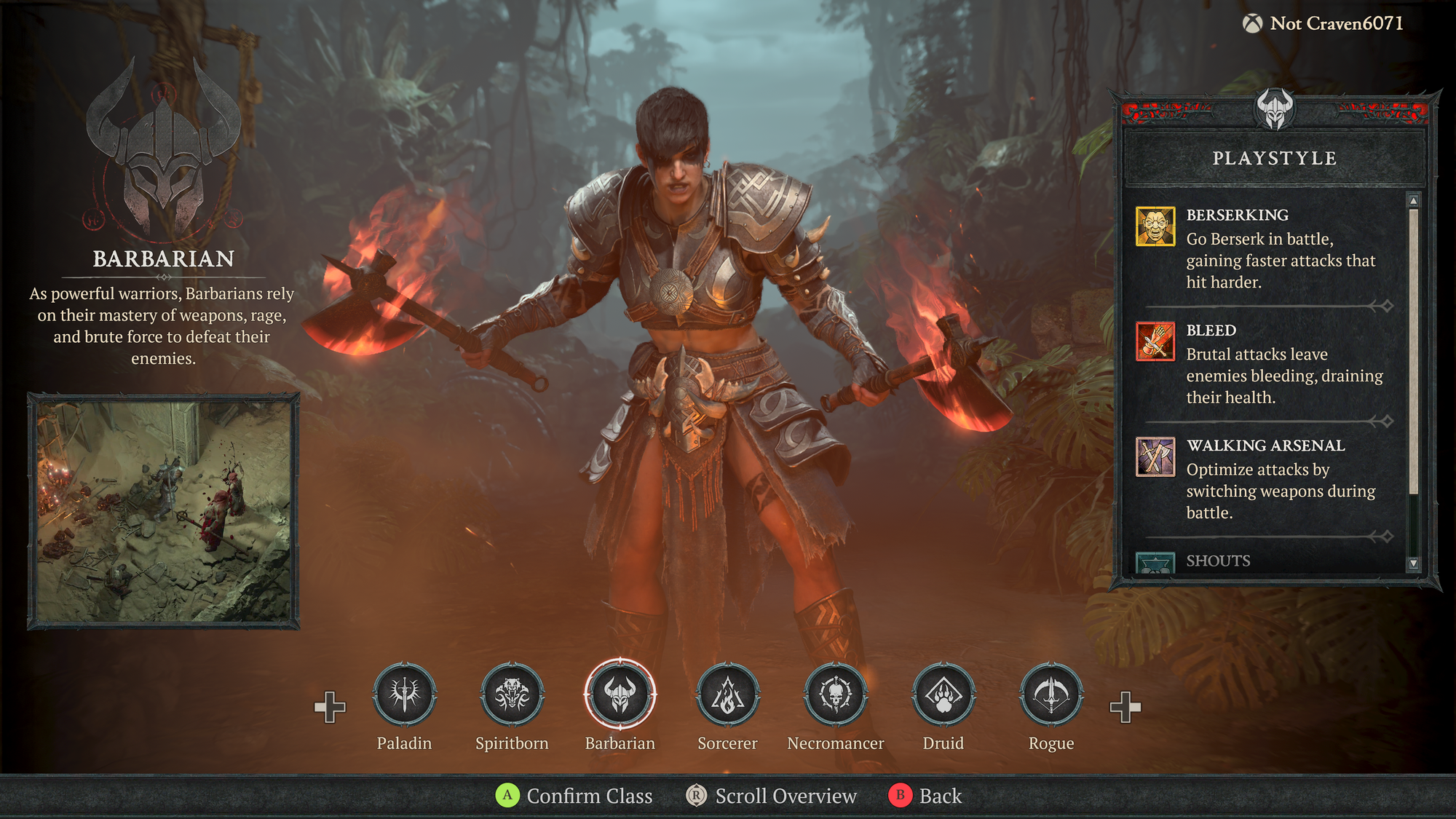
The Barbarian: Discharge
You want to be in the middle of it. You want to charge, to leap, to feel the impact of steel on flesh rendered in screen shake and sound design. The Barbarian doesn't think about combat. The Barbarian is combat—lunging into a pack of enemies before the tactical brain has time to calculate whether it's wise.
The Barbarian player under stress is seeking somatic discharge. The concept comes from Peter Levine's somatic experiencing framework, which proposes that traumatic experiences leave the body holding undischarged survival energy—fight-or-flight activation that was mobilized but never completed. This energy doesn't dissipate on its own. It stays in the muscles, the breath, the chronic tension that no amount of thinking resolves.
The Barbarian class offers a container for that energy. The gameplay is physical in its rhythm—button-mashing, screen-clearing, the satisfying thud of a Hammer of the Ancients connecting with a crowd. The sensorimotor networks engaged by this kind of play help reconnect emotional experience with physical action, supporting grounding through embodied engagement rather than cognitive processing.
If you reach for the Barbarian when you're activated, your body may be asking for something your mind can't provide: not understanding, but movement. Not insight, but impact. The nervous system doesn't always need to make sense of what happened. Sometimes it just needs to finish what it started.
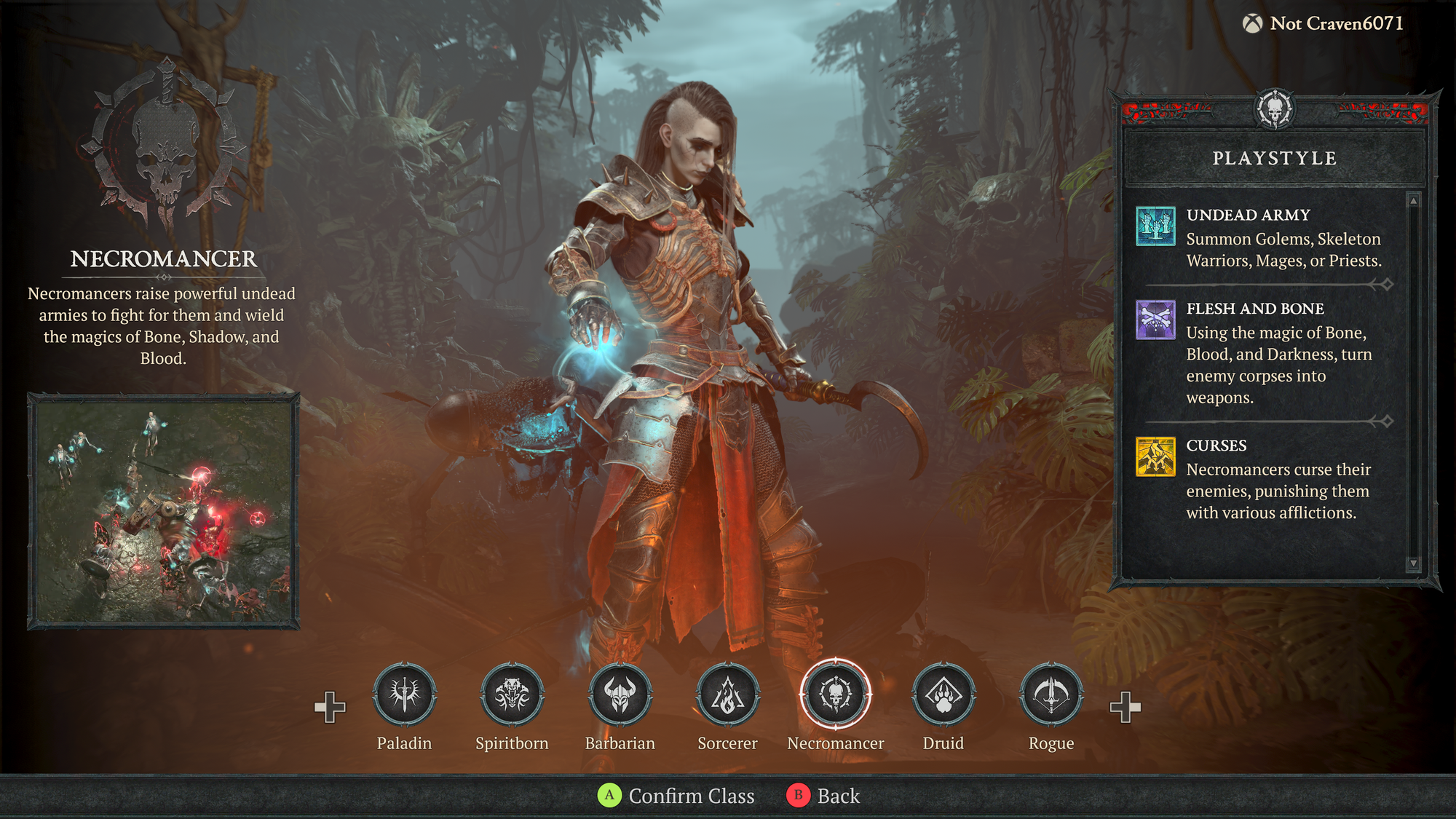
The Necromancer: Orchestration
You hang back. You summon. You position your skeletal army, curse the battlefield, and watch your systems interact. The Necromancer doesn't wade into chaos—the Necromancer manages chaos, converting the frenzy of combat into something orderly, something with moving parts that you control.
The Necromancer player under stress is seeking cognitive control. This engages the dorsolateral prefrontal cortex—the brain region most associated with executive function, planning, and working memory. When this area is active, it creates emotional distance. Not avoidance, necessarily, but a buffer between the feeling and the response. A space in which to think.
For people who learned early to manage complex systems—who were parentified, who became the responsible one, who survived by being the person in the room who could see all the pieces—the Necromancer fantasy isn't about death or darkness. It's about competence in the face of overwhelm. It's the experience of having more variables than any one person should be managing and managing them anyway.
There's a clinical parallel to intellectualization, a defense mechanism in which emotional distress is converted into abstract thinking. Intellectualization isn't inherently unhealthy—it's a sophisticated strategy that serves many people well, particularly in professional contexts. But it can become a default that prevents emotional processing if the thinker never comes back down into the body.
If you reach for the Necromancer when you're hurting, your system may be asking for structure. For the experience of being the architect rather than the inhabitant of your distress. The question worth sitting with is whether the distance is a strategy or a habit—whether you're choosing the high ground or whether you've forgotten there's a ground floor.
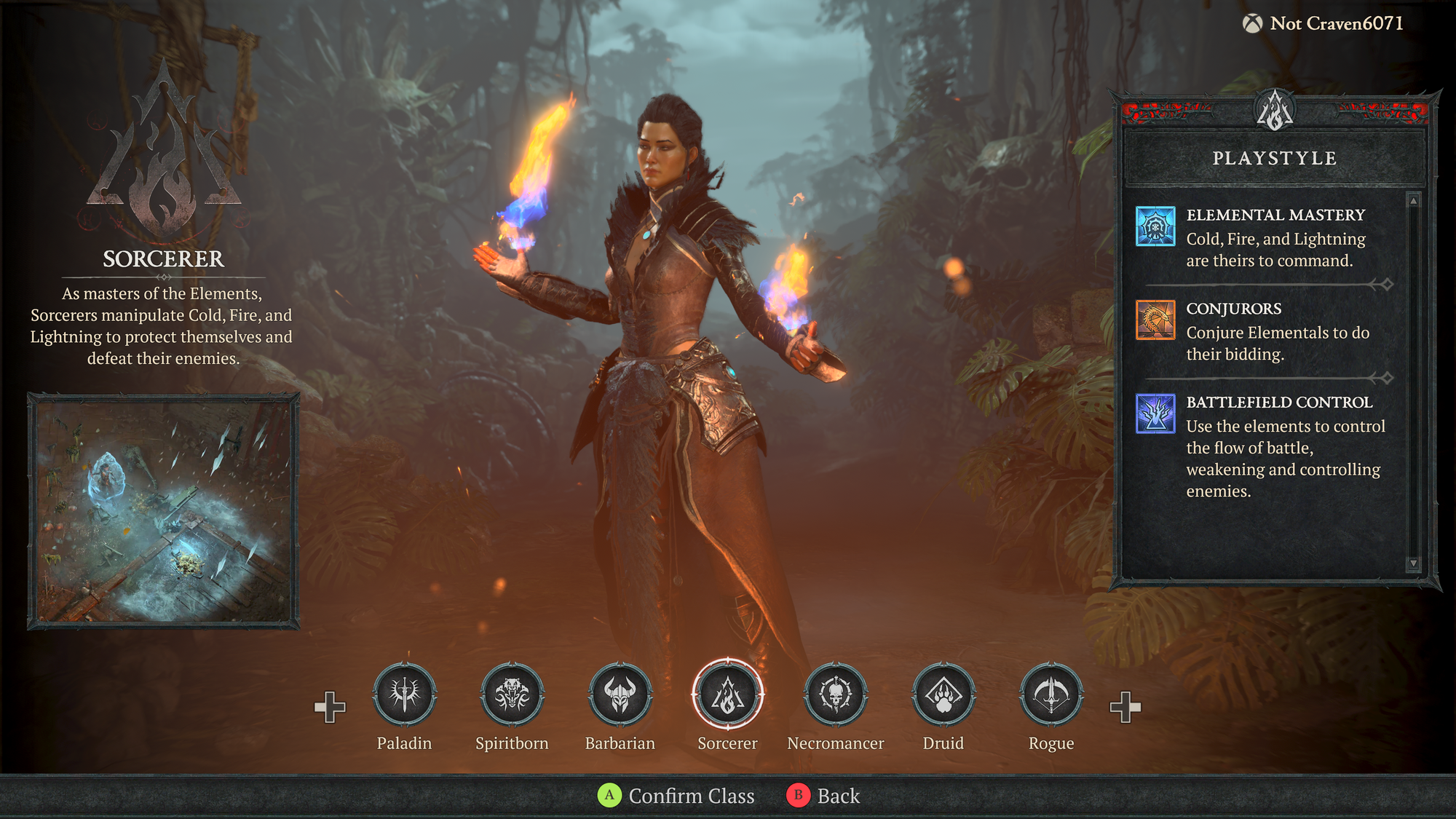
The Sorcerer: Release
You're fragile and devastating. One wrong step and you're dead. But when the build is firing—when the chain lightning arcs across the screen or the meteor lands in the center of a mob—the output is extraordinary. The Sorcerer doesn't survive through endurance. The Sorcerer survives through expression, converting vulnerability into spectacle.
The Sorcerer player under stress is seeking emotional release through amplification. This is the high-risk, high-reward class, the glass cannon, and its appeal maps onto a specific emotional profile: people who feel things at full volume and have learned to channel intensity rather than contain it.
Clinically, this resonates with emotional sensitivity—what Marsha Linehan's biosocial model describes as a temperament characterized by high reactivity, slow return to baseline, and a narrow window between stimulus and response. People with this sensitivity are often told they're "too much." Too intense. Too emotional. Too reactive. The message, internalized over years, is that their natural amplitude is a problem to be solved.
The Sorcerer fantasy inverts this. In Diablo IV, intensity is power. The same quality that makes the Sorcerer fragile—low defenses, high sensitivity to positioning—is what makes it capable of devastating output. The fragility isn't a bug. It's the cost of the gift.
If you reach for the Sorcerer when you're overwhelmed, your system may be asking for permission to be loud. To take up space. To stop modulating and let the full charge move through you, even if it's dangerous, even if it means you might shatter, because the alternative—holding it all in—is worse.
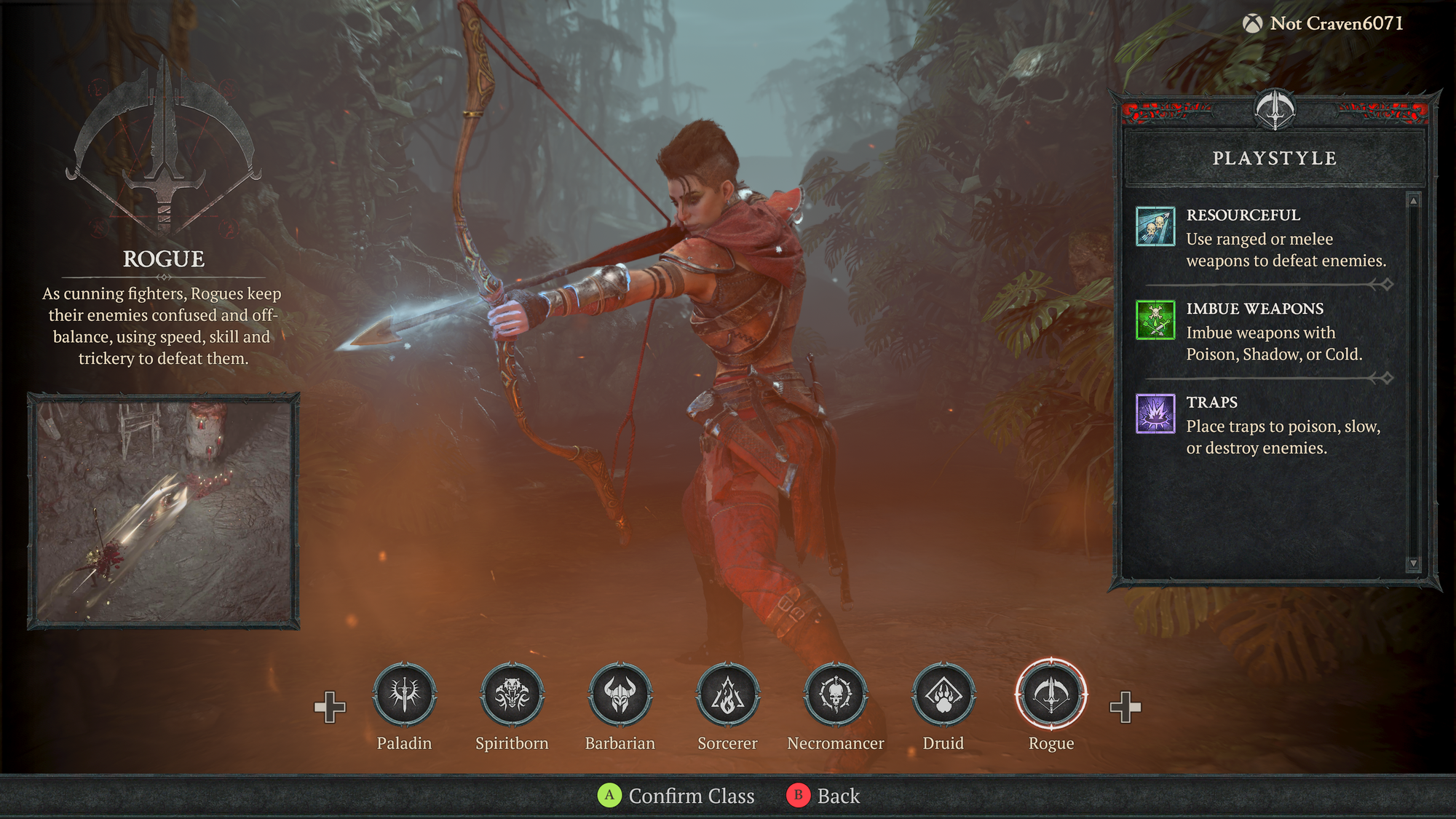
The Rogue: Control Through Precision
You don't stand still. You dart in, strike, vanish. You read the battlefield the way some people read rooms—identifying threats, calculating escape routes, never committing to a position longer than necessary. The Rogue is always aware of where the exit is.
The Rogue player under stress is seeking hypervigilant control. The gameplay rewards the same skills that survival in unpredictable environments develops: constant environmental scanning, rapid threat assessment, the ability to disappear when the situation becomes dangerous.
In attachment terms, this pattern resonates with dismissive-avoidant strategies. The Rogue doesn't need the party. The Rogue manages distance—close enough to strike, far enough to escape. Intimacy with the combat is brief and precisely controlled. The playstyle is efficient, elegant, and relentlessly self-reliant.
There's also a connection to the fawn-to-fight continuum. Some people who developed hypervigilance in response to volatile caregivers learned to read rooms so accurately that they could preempt conflict—adjusting their behavior before the threat materialized. The Rogue does something similar: engaging the battlefield on its own terms, never allowing the enemy to dictate the encounter.
If you reach for the Rogue when you're anxious, your system may be telling you it doesn't feel safe to stay in one place. That commitment—to a position, a strategy, a relationship with the melee—feels like exposure. The Rogue's gift is adaptability. The question is whether the constant movement is strategic or whether it's the only option your system believes it has.
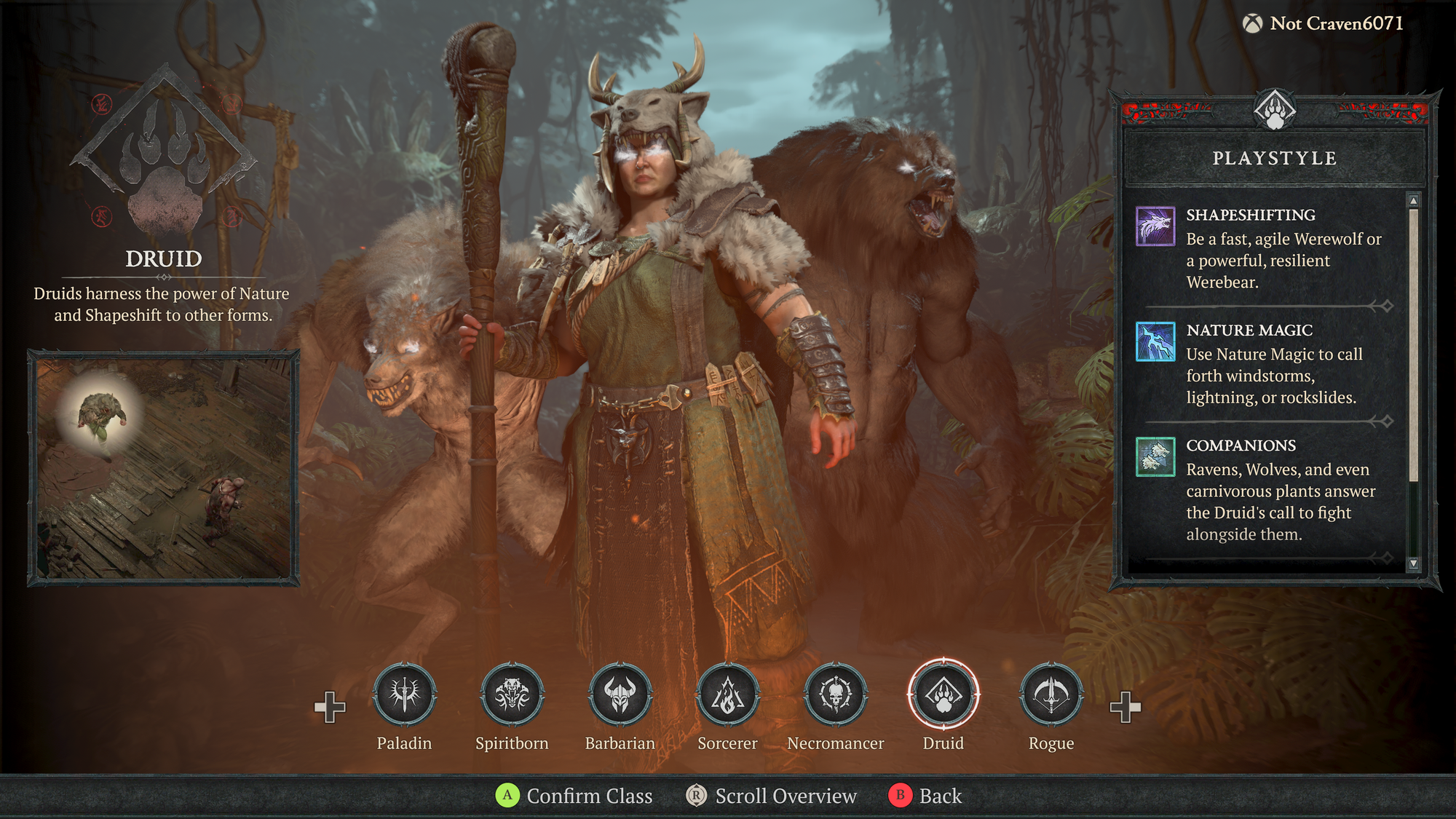
The Druid: Integration
You shapeshift. One moment you're a bear, absorbing damage with primal endurance. The next you're a wolf, fast and vicious. Then you're human again, casting storms, directing the earth itself. The Druid doesn't commit to one way of being. The Druid moves between forms, drawing on different capacities as the situation demands.
The Druid player under stress is seeking integration—the ability to hold multiple modes of being within a single identity. This resonates powerfully with Richard Schwartz's Internal Family Systems model, which frames the psyche as a system of parts, each with its own role, perspective, and strategy. Health, in IFS, isn't about eliminating parts but about allowing a core Self to lead while parts contribute their strengths.
The Druid literally embodies this. Bear form is the Protector—absorbing damage so the system survives. Wolf form is the part that acts on instinct, fast and direct. Caster form is the part that sees the larger picture, summoning elemental forces that operate on a different scale. The Druid doesn't choose between these. The Druid is all of them, shifting fluidly based on what the moment requires.
For people who experience code-switching—neurodivergent individuals who mask, people navigating multiple cultural contexts, anyone who's learned to present different selves in different environments—the Druid's shapeshifting may carry particular resonance. The fantasy isn't about deception. It's about the possibility that all of your forms are real, that shifting between them doesn't make you fragmented but flexible.
If you reach for the Druid when you're dysregulated, your system may be seeking permission to be more than one thing. To stop performing coherence and instead practice fluidity. The Druid's power comes not from any single form but from the willingness to change shape without losing the self underneath.
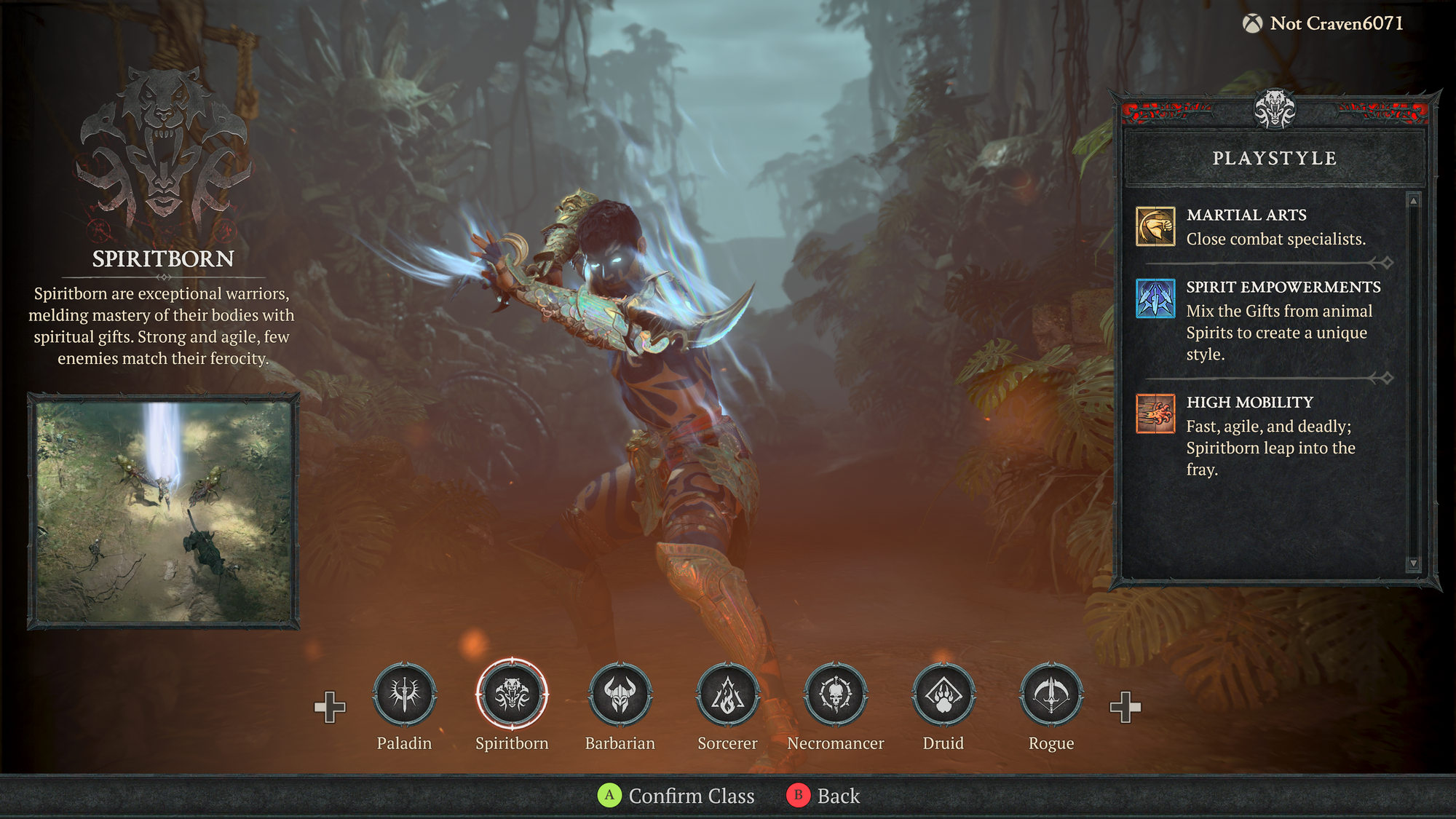
The Spiritborn: Connection
You channel ancestral power. Your abilities are drawn from spiritual lineages—the Jaguar, the Eagle, the Gorilla, the Centipede—each representing a different kind of inherited strength. The Spiritborn doesn't fight alone. The Spiritborn fights as part of a lineage, drawing on something larger than individual capability.
The Spiritborn player under stress is seeking meaning through connection—to heritage, to something beyond the self, to a sense that the struggle is part of a larger story.
This maps onto what trauma researchers call post-traumatic growth—the phenomenon in which people who've endured significant suffering sometimes develop deepened relationships, increased appreciation for life, and a stronger sense of meaning or spiritual connection. Post-traumatic growth isn't the silver lining of trauma. It's not a justification for suffering. It's a description of something that sometimes emerges when a person has the resources to make meaning from what happened to them.
Viktor Frankl's logotherapy proposed that the search for meaning is the primary human motivation, and that even suffering becomes bearable when it can be placed within a meaningful framework. The Spiritborn's connection to ancestral spirits offers exactly this: a context in which individual struggle is part of something continuous and purposeful.
If you reach for the Spiritborn when you're lost, your system may be asking for belonging. For the felt sense that you're part of something that started before you and will continue after you. That your fight matters not just to you but to a lineage that holds you.
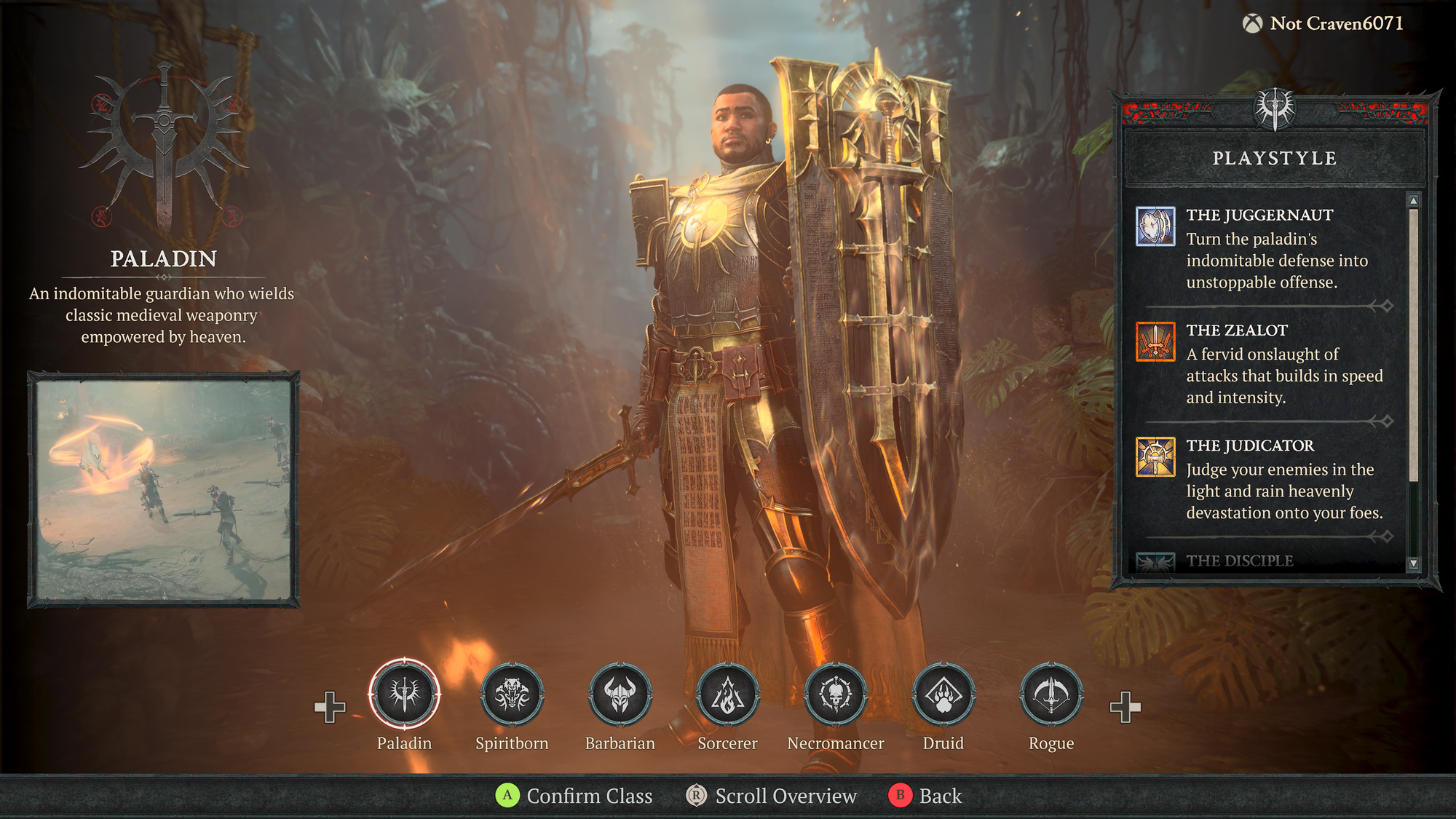
The Paladin: Purpose
You stand between evil and everything it wants to destroy. Shield raised. Light blazing. The Paladin doesn't fight for loot or survival or the thrill of combat. The Paladin fights because it's right. Because someone has to. Because faith isn't a passive belief but an active stance—a body placed deliberately in the path of harm.
The Paladin player under stress is seeking regulation through moral conviction. Where the Barbarian discharges and the Necromancer orchestrates, the Paladin commits—to a purpose, a code, a reason to stand firm when the nervous system is screaming to flee.
The three Oath paths within the Paladin class reveal different flavors of this pattern. The Zealot channels righteous intensity—regulation through purposeful action, the conviction that fury is sanctified when it serves a cause. The Juggernaut becomes immovable—regulation through impermeability, the shield raised not just against enemies but against the possibility of being shaken. The Judicator creates consecrated ground—regulation through boundary-setting, transforming the battlefield itself into something structured and holy.
Clinically, the Paladin resonates with the caretaker identity. Many people who gravitate toward protector roles—in their families, their professions, their communities—learned early that their value was contingent on standing between others and harm. This is a pattern with deep roots in parentification, in families where the child became the emotional guardian, in cultures where sacrifice is conflated with worth.
There's also a connection to moral injury—the psychological damage that results from actions, or failures to act, that violate a person's moral code. Veterans, healthcare workers, first responders, and therapists are particularly vulnerable to moral injury. The Paladin fantasy offers a world in which moral action is always available, always effective, and always clear. For someone carrying the weight of situations where they couldn't protect, couldn't intervene, couldn't stand firm enough, the Paladin is a space to practice the conviction that holding your ground is possible.
If you reach for the Paladin when you're hurting, your system may be asking for a reason. Not just to cope, but to matter. The Paladin's power comes from faith—not necessarily religious faith, but the bone-deep belief that standing in the light is worth the cost. The question worth asking is whether the purpose sustains you or whether it's become the only way you know how to justify your presence.
Switching Classes
Here's where the framework becomes most clinically interesting.
Most Diablo IV players don't main a single class permanently. They switch. Sometimes between sessions, sometimes between seasons, sometimes in the middle of a bad week when the Necromancer's distance stops working and the mind demands the Barbarian's impact.
This switching isn't indecision. It's adaptive self-regulation.
The window of tolerance model helps explain why. Different states require different interventions. A person locked in hyperarousal—anxious, restless, thoughts racing—needs something that either channels or calms the activation. A person in hypoarousal—numb, flat, disconnected—needs something that gently increases arousal without triggering overwhelm. The goal isn't a single fixed state but the flexibility to move back into the window from whichever direction you've fallen out of it.
The classes map onto this continuum. The Barbarian and Sorcerer are high-arousal classes—they match and channel activation, meeting a hyperaroused system where it already is and giving the energy somewhere to go. The Necromancer and Rogue are controlled-arousal classes—they impose structure and precision on chaos, offering a way to step back from flooding without collapsing into shutdown. The Druid is a flexible-arousal class—it shifts to match whatever's needed, moving between intensity and strategy in real time. The Spiritborn and Paladin are meaning-making classes—they regulate not through intensity or control but through connection to something larger than the current distress.
When you switch from the Necromancer to the Barbarian mid-week, you may be recognizing, below the level of conscious thought, that cognitive control has stopped working and your body needs to move. When you switch from the Barbarian to the Druid, you may be recognizing that discharge has peaked and what you need now is flexibility. When you reach for the Paladin after a week of Rogue gameplay, you may be recognizing that self-reliance has become isolation and what your system craves is a reason to stand somewhere.
Barrett's predictive processing model offers a way to understand this switching at a neurological level. The brain is constantly generating predictions about what the body needs to maintain what Barrett calls its "body budget"—the ongoing allocation of metabolic resources. When a current strategy stops producing the expected regulatory return, the brain updates its prediction and reaches for something different. The class switch isn't random. It's the brain revising its model of what will bring the system back into balance.
The switching is the skill. It's the nervous system doing what a well-regulated system does: assessing its own state and reaching for the intervention that fits.
The Practice Space
Diablo IV isn't therapy. The class selection screen isn't a diagnostic tool. Nothing in this post should be treated as a clinical assessment.
But games are mirrors. They reflect patterns back to us with enough distance that we can look at them without flinching. The approval system in Dragon Age reveals attachment patterns. The class system in Diablo IV reveals regulatory strategies.
The invitation is the same in both cases: get curious.
The next time you sit down to play, notice which class you reach for. Notice whether it's the same one you always pick or whether something has shifted. Notice what your body feels like before you choose—activated, numb, restless, heavy—and whether the class you select matches that state or opposes it.
You don't have to do anything with the information. You don't have to change your playstyle or optimize your coping. But if you're someone who's ever wondered why a particular game feels like medicine on a particular kind of day, the answer might be simpler than you think.
Your nervous system knows what it needs. The class you choose is how it asks.