When the Scout is Watching — Using College Football 26 to Practice Imperfection

How a video game recruiting visit activated real perfectionism—and became an unexpected lesson in sitting with discomfort.
I know my pattern with perfectionism.
Something appears—an opportunity, a challenge, a situation where I could fail—and my brain immediately jumps to the worst possible outcome. I might fail, and that failure will be catastrophic and permanent. The panic rises. And then, almost protectively, my mind offers a solution: Just don't do it. If you don't try, you can't fail. The potential cost is too great.
It's a pattern rooted in something much deeper than fear of failure. Somewhere along the way, I learned that perfection was the price of admission—that being flawless was how I might finally earn the love I'd been striving for my whole life. And the inverse carved itself just as deep: if I fail at this thing, even one thing, then they were right all along. I'm not worthy. I never was.
This is the engine running beneath what might look, from the outside, like simple procrastination or avoidance. It's not laziness. It's a desperate, exhausting calculation: Is the possibility of success worth the risk of confirming my deepest fear about myself?
Most of the time, the answer comes back no. So I don't do the thing.
I share this because of what happened when I sat down to play EA's College Football 26.
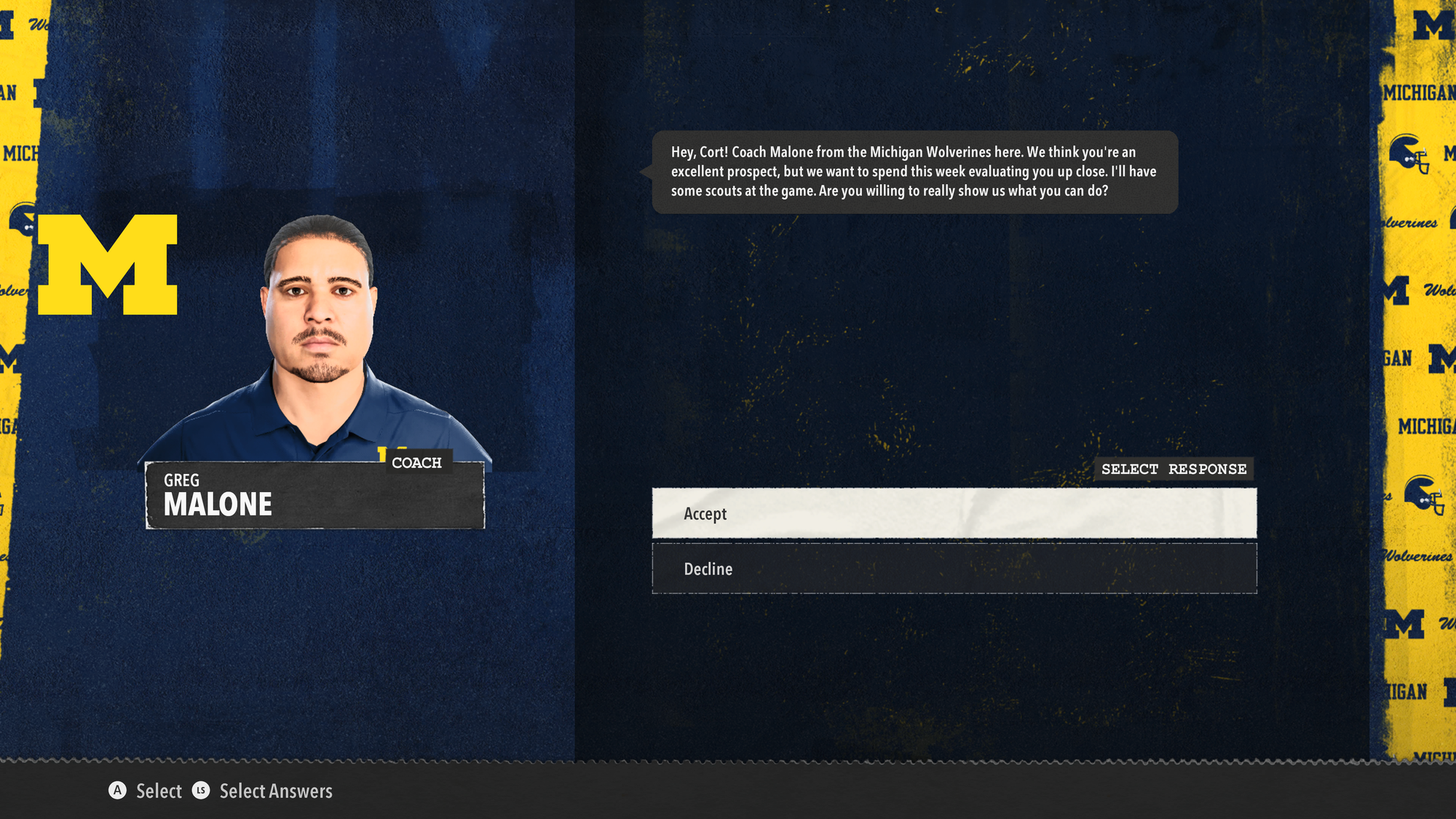
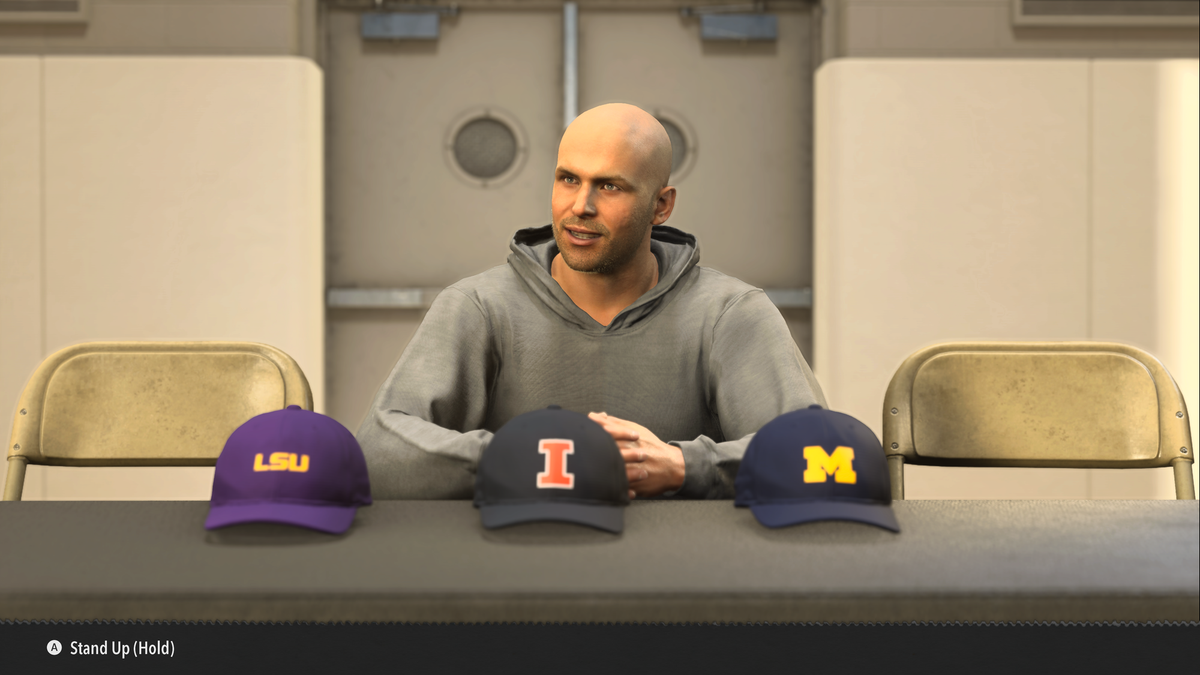
During the "High School Experience" career mode, you're working to earn scholarship offers from your top ten schools. The mode puts you in the helmet of a high school athlete trying to prove yourself—grinding through games, building stats, hoping the right programs notice. I'd ranked the University of Michigan first. My dream program, even in a fictional career. Then the game notified me: Michigan is sending a scout to your next game. They'll be watching.
And there it was. The pattern.
My chest tightened. My grip on the controller shifted. The thoughts came fast and familiar: If I throw an interception, that's it. They'll pull the offer. I'll have ruined everything. My whole game experience will change. I'll have to go to a terrible school and then when I play Madden, that experience will be impacted too. Now there's too much pressure.
I felt the urge I always feel: Just don't do it. Turn off the game. You don't have to play this mode. You don't have to risk failing at this.
But here's the thing about a video game: it's a playground. A "what if" space. The stakes felt real—my nervous system was certainly convinced—but the consequences weren't. Not really. No actual scholarship hung in the balance. No real future would be derailed by a virtual interception. I had a chance to face the pattern and ask: What if I don't avoid it this time? What if I play through the panic and see what actually happens?
So I did.
This is exactly why I believe games are underutilized in therapeutic work. Not because they're escapism, but because they're the opposite—they're mirrors. And sometimes, they're practice arenas for the very patterns we're too afraid to confront in real life.
The Scout in the Stands: Externalizing the Inner Critic
What College Football 26 did, without intending to, was externalize something most of us carry invisibly: the sense that we're being evaluated, and that anything less than perfection means failure.
In cognitive-behavioral terms, this is catastrophic thinking—jumping to the worst possible outcome and treating it as inevitable. The cognitive distortion doesn't just predict failure; it treats failure as both certain and unsurvivable. It often rides alongside all-or-nothing thinking, where performance exists only as "perfect" or "disaster," with no middle ground. A single interception wouldn't just be a mistake; it would be the mistake—the one that defines everything.
Aaron Beck's cognitive model suggests that these automatic thoughts often operate below conscious awareness, shaping our emotional responses before we've had a chance to evaluate them. We don't decide to catastrophize; the thought arrives fully formed, presenting itself as fact rather than interpretation.
The game literalized my internal critic by putting an actual evaluator in the stands. Suddenly, the cognitive distortion wasn't just a thought pattern—it was a character with a clipboard. The scout became a visible stand-in for every internal voice that has ever whispered they're watching, don't mess this up, you only get one chance.
For anyone who's experienced performance anxiety, perfectionism, or the chronic sense of being watched and judged, this moment might feel familiar. The game didn't create these patterns; it revealed them. And there's something uniquely valuable about seeing our internal experiences reflected in external, concrete form. It creates distance—just enough to notice what's happening rather than being completely fused with it.
Playing Through: Distress Tolerance in Action
Here's what games offer that pure imagination or talk therapy sometimes can't: you have to keep going.
I couldn't pause indefinitely to process my feelings. I couldn't reframe my thoughts for twenty minutes before acting. I couldn't journal about my anxiety or call a friend to talk it through. The play clock was running. The defense was shifting. I had to throw the ball while my nervous system was activated and my brain was screaming about consequences.
This maps onto a core principle in Dialectical Behavior Therapy's distress tolerance skills: sometimes the goal isn't to eliminate discomfort, but to act effectively while experiencing it. Marsha Linehan developed these skills for individuals who experience emotions so intensely that they can become overwhelming, but the underlying principle applies broadly. Life regularly asks us to function before we feel ready—to make decisions while uncertain, to perform while anxious, to move forward while afraid.
The DBT framework distinguishes between changing painful emotions and tolerating them when change isn't immediately possible. The acronym TIPP (Temperature, Intense exercise, Paced breathing, Paired muscle relaxation) addresses acute physiological distress, but the broader skill set—what Linehan calls "radical acceptance" and "willingness"—involves acknowledging reality as it is and choosing to participate in life anyway.
College Football 26 forced me into that practice without giving me time to intellectualize it. Each snap was a small act of willingness: I don't know if this will go well, and I'm doing it anyway. Each completed pass was evidence that I could function under pressure. Each decision made while anxious was a repetition, building the experiential knowledge that discomfort doesn't have to mean paralysis.
The game created what I'd call "structured imperfection practice." I couldn't wait until I felt confident. I had to act while uncertain—and discover that action was still possible.
Exposure to "Good Enough"
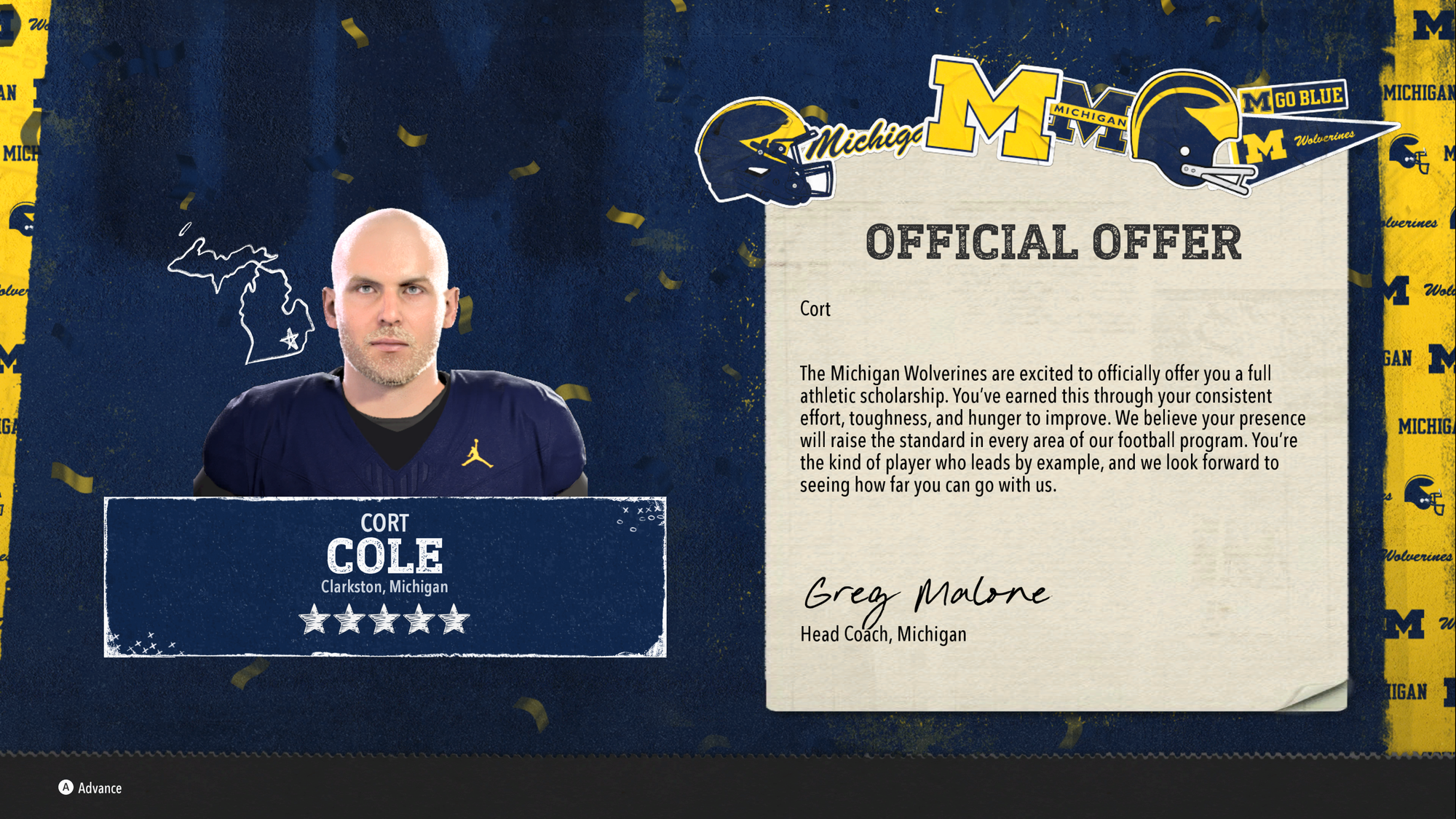
Perhaps the most valuable element was what happened after.
Michigan made the offer. Full athletic scholarship. Verbal commitment accepted. Despite my imperfect game, despite being sacked once, the outcome I catastrophized never materialized.
This is the engine of exposure therapy: approaching feared situations and collecting evidence that disconfirms our worst predictions . The theory behind exposure isn't simply habituation—getting used to something through repeated contact—but inhibitory learning. Each exposure creates new associations that compete with the old fear-based learning. We don't erase the original fear; we build new learning that says this situation can also mean safety.
Each exposure is a data point. Over time, the nervous system learns that the feared outcome either doesn't happen or, more importantly, is survivable if it does. The goal isn't to guarantee success; it's to build tolerance for uncertainty and confidence in our ability to cope with whatever happens.
Games offer a unique exposure environment because the stakes are real enough to activate our patterns but consequence-limited enough to make experimentation safe. I couldn't actually lose a college scholarship. My actual future wasn't riding on a virtual quarterback's arm. But my brain didn't fully know that in the moment—the emotional and physiological response was genuine, which meant the corrective experience still landed.
This is what makes games potentially powerful for anxiety work: they exist in a middle space between pure imagination (which often doesn't activate the nervous system enough to create change) and real-world exposure (which can often feel too risky to attempt). The virtual scout in the stands created real anxiety. The successful outcome created real relief. And the learning—I can perform imperfectly and still be enough—has the potential to generalize beyond the game.
The Meta-Moment: Knowing and Feeling
There's a strange experience that happens in moments like this—a split consciousness where part of you knows the truth while another part responds as if the threat is real.
I knew it was a game. I knew I could restart the career mode if everything went wrong. I knew that no actual university was evaluating my worth as a person based on my controller skills. And yet my palms were sweating anyway.
This gap between knowing and feeling is something many people experience with anxiety. The logical brain can recite all the reasons a fear is irrational or disproportionate, while the emotional brain and body continue responding to perceived threat. This isn't a failure of intelligence or insight—it's how our nervous systems are wired. The amygdala, which processes threat, operates faster than the prefrontal cortex's rational evaluation. We feel before we think.
Games make this split visible. They give us a container where we can observe ourselves having irrational responses to fictional stakes—and that observation itself can be therapeutic. It's harder to shame yourself for "overreacting" to real-life situations when you've watched yourself have the same response to a video game. The pattern becomes recognizable as a pattern, something the brain does, rather than evidence of personal failing.
The Utility of the Virtual Arena
What strikes me about this experience isn't that a football game taught me something about myself. It's that the game created conditions I couldn't have manufactured alone:
- An external representation of internal judgment. The scout made visible what usually stays invisible—the felt sense of being watched and evaluated. When we can see the critic, we can start to examine it.
- Forced action under emotional activation. Unlike journaling or meditation, the game demanded performance while my nervous system was activated. This is closer to how real life works—we rarely get to wait until we're calm to act.
- Immediate, concrete feedback on catastrophic predictions. I predicted disaster. Disaster didn't happen. The game gave me that corrective data point within minutes, not months.
- A bounded space for experimentation. The consequences were real enough to matter emotionally but limited enough that failure wouldn't be devastating. This is the sweet spot for learning.
- Repeatable practice. Unlike many real-life high-stakes situations, I can run this scenario again. Different games, different scouts, different pressure moments—each one an opportunity to practice tolerating uncertainty and acting anyway.
This isn't a replacement for therapy. It's not a substitute for professional support when anxiety becomes impairing or perfectionism turns self-destructive. But for those of us prone to perfectionism, avoidance, or anxiety-driven paralysis, games can serve as practice fields—places to experiment with imperfection and discover we survive it.
An Invitation to Notice
If you play games—any games—I'd offer this invitation: pay attention to the moments that activate you disproportionately to the actual stakes.
Notice when you restart a level because "good enough" felt intolerable. Notice when you avoid a challenge because the possibility of failure feels worse than the certainty of not trying. Notice when your body responds to fictional consequences as if they were real.
These moments aren't evidence that you're taking games too seriously. They're data about how your nervous system responds to pressure, judgment, and uncertainty. They're invitations to practice something different—to play imperfectly, to tolerate discomfort, to discover that you're still standing after the thing you feared.
The scout was watching. I wasn't perfect. And Michigan still wanted me.