Why Games Speak My Language

Understanding How Autistic Brains Process Emotion Through Play
After my mother died, I couldn't name what I was feeling.
I knew something was happening inside me—something large and complicated and painful. But when I tried to identify it, to put words to it, I found only static. Grief, obviously. But grief didn't capture the texture of it, the layers, the way it seemed to be multiple things at once that I couldn't pull apart.
Forty-three years. That's how long my mother had been part of the fabric of my existence. The question wasn't just "how do I grieve her"—it was "who am I without her as part of the context I exist in?" And tangled up in that was another question: who is my dad to me now, without the person who always bridged us?
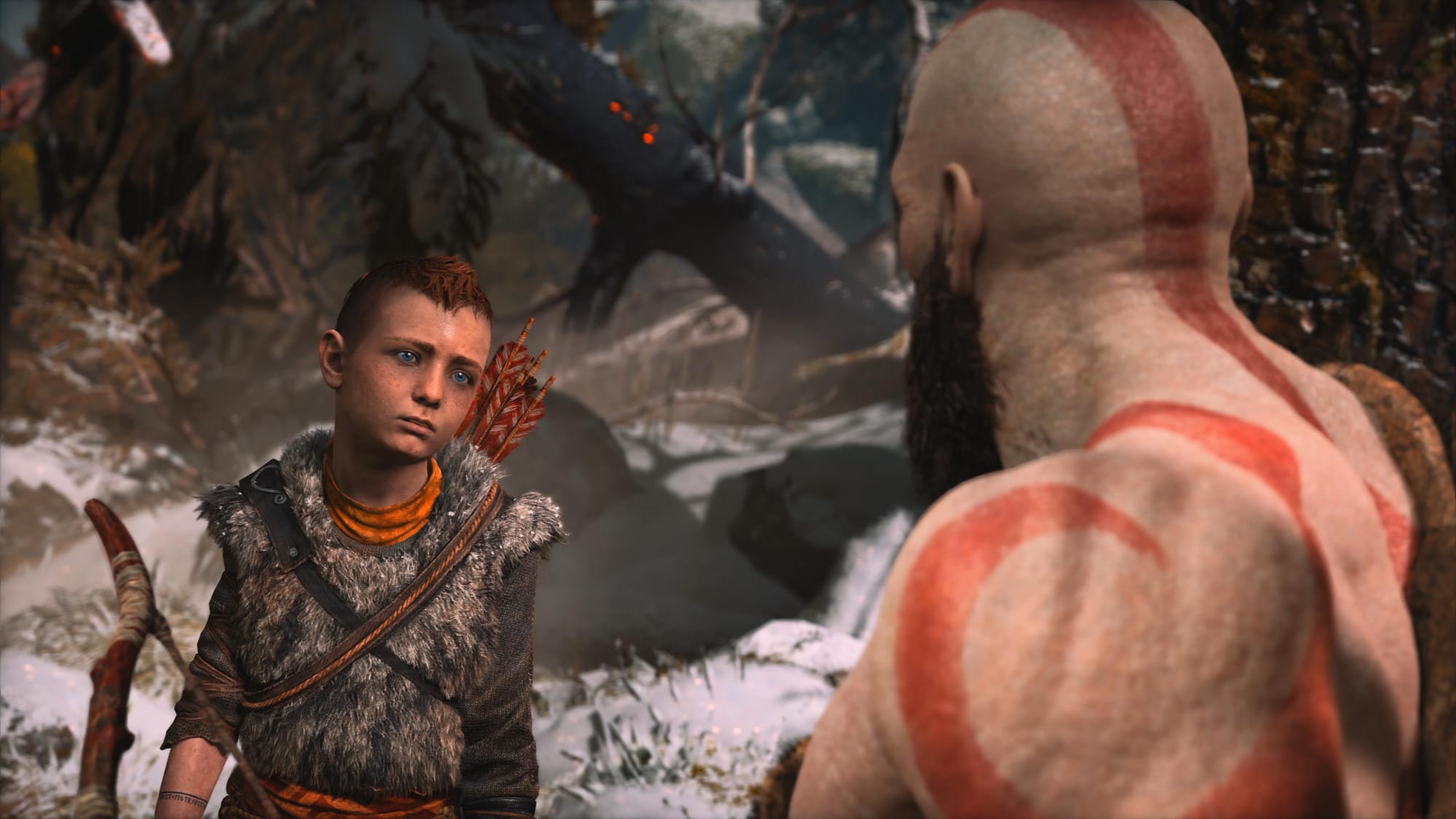
My mom was that bridge. She softened my dad's edges before they reached me. She helped him understand things about me that didn't come naturally to him. She translated between two people who loved each other but didn't quite speak the same language. I didn't fully see that labor until it was gone—until my dad and I were standing there without the person who facilitated our connection.
So I was carrying two griefs at once: the solitary work of learning to exist in a world that had fundamentally changed, and the relational work of reaching toward someone who was still here, without the person who used to make that reaching easier.
I couldn't name any of this. Not clearly. Not in a way that let me work with it.
Then I returned to God of War.
Finding the Shape of It
When God of War released in 2018, I saw my relationship with my father mirrored immediately in Kratos's relationship with Atreus. The emotional distance, the struggle to connect, the way love existed but couldn't quite find its expression—I recognized all of it. I played through the entire game feeling that resonance, that sense of this is us, this is what we're like.
I never imagined I'd be living the story.
But here I am—my father and I left without my mother, trying to figure out how to talk to each other. The game I once observed from the outside has become the narrative I'm inside of now.
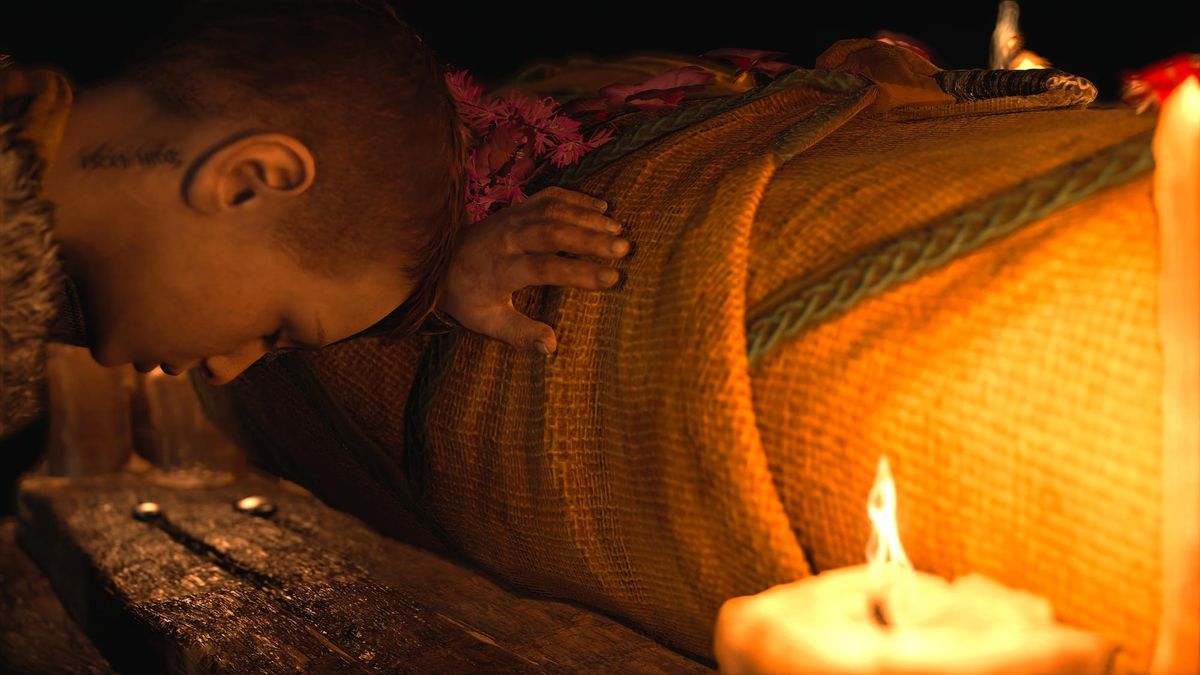
The entire premise of God of War is a grief ritual. Kratos and Atreus are on a pilgrimage to scatter Faye's ashes—Kratos's wife, Atreus's mother. She was the one who softened Kratos, who taught Atreus their language, who held the family's emotional center. Her absence doesn't just leave a hole; it changes the geometry of every remaining relationship.
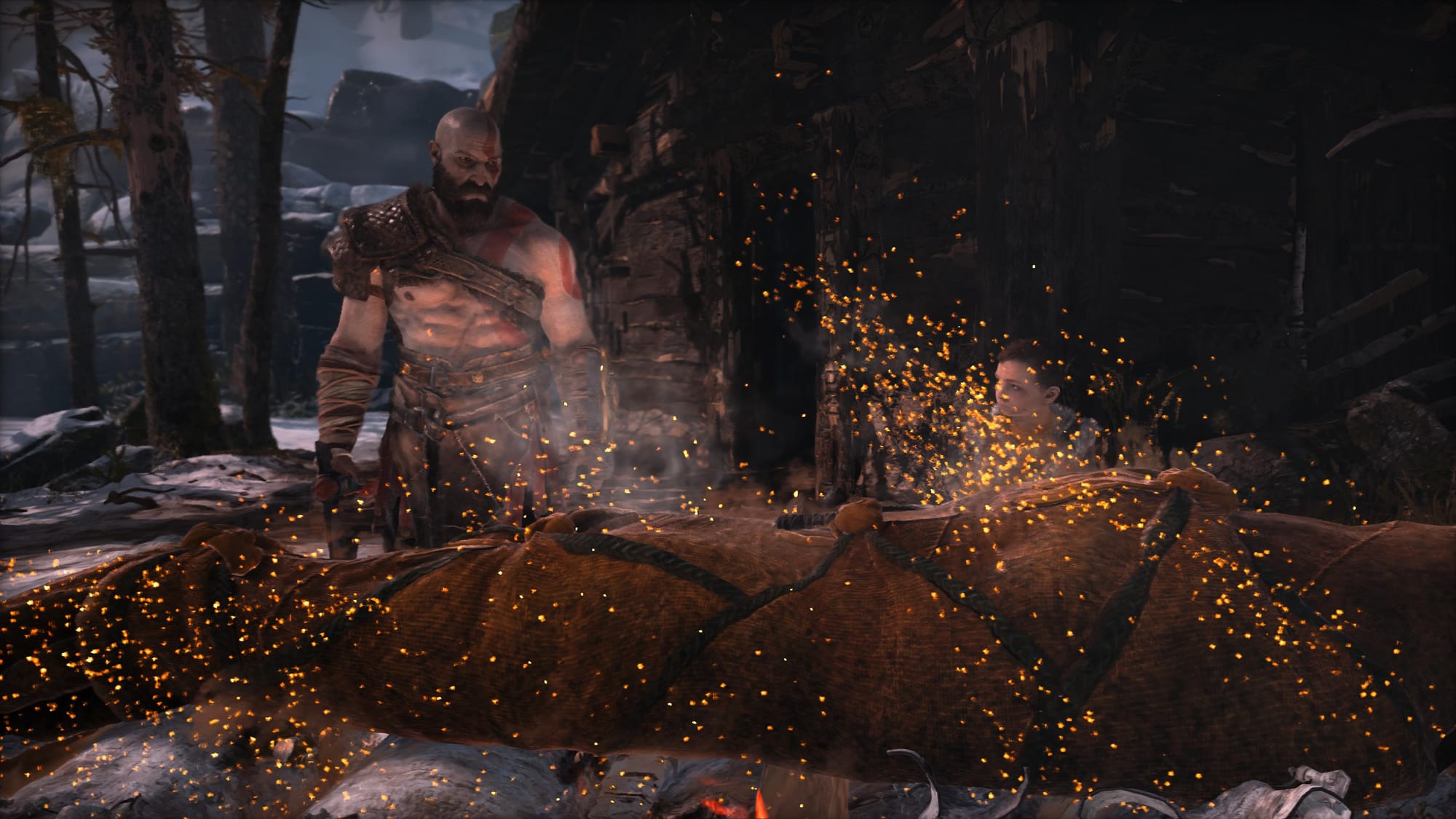
Returning to the game after my mother's death, watching Kratos struggle to put his hand on his son's shoulder, I felt something click into place with new force. That. That was the shape of what I was experiencing with my dad. Two people who love each other, trying to reach each other directly, without the person who used to make the connection flow.
The game gave me a visible, external representation of something I'd been carrying but couldn't articulate. Kratos's emotional unavailability isn't villainized—it's shown as the survival mechanism it is, and the cost of that mechanism is visible in real time through his relationship with Atreus. I could see the pattern: grief that isn't processed doesn't disappear; it shapes everything around it.
Around the same time, I was playing Kingdom Come: Deliverance. Henry's loss is different—total and sudden. Both parents, his home, his entire known world, in a single act of violence. He starts with nothing. No skills, no status, no idea who he's supposed to become. He's just a blacksmith's son who can barely swing a sword.
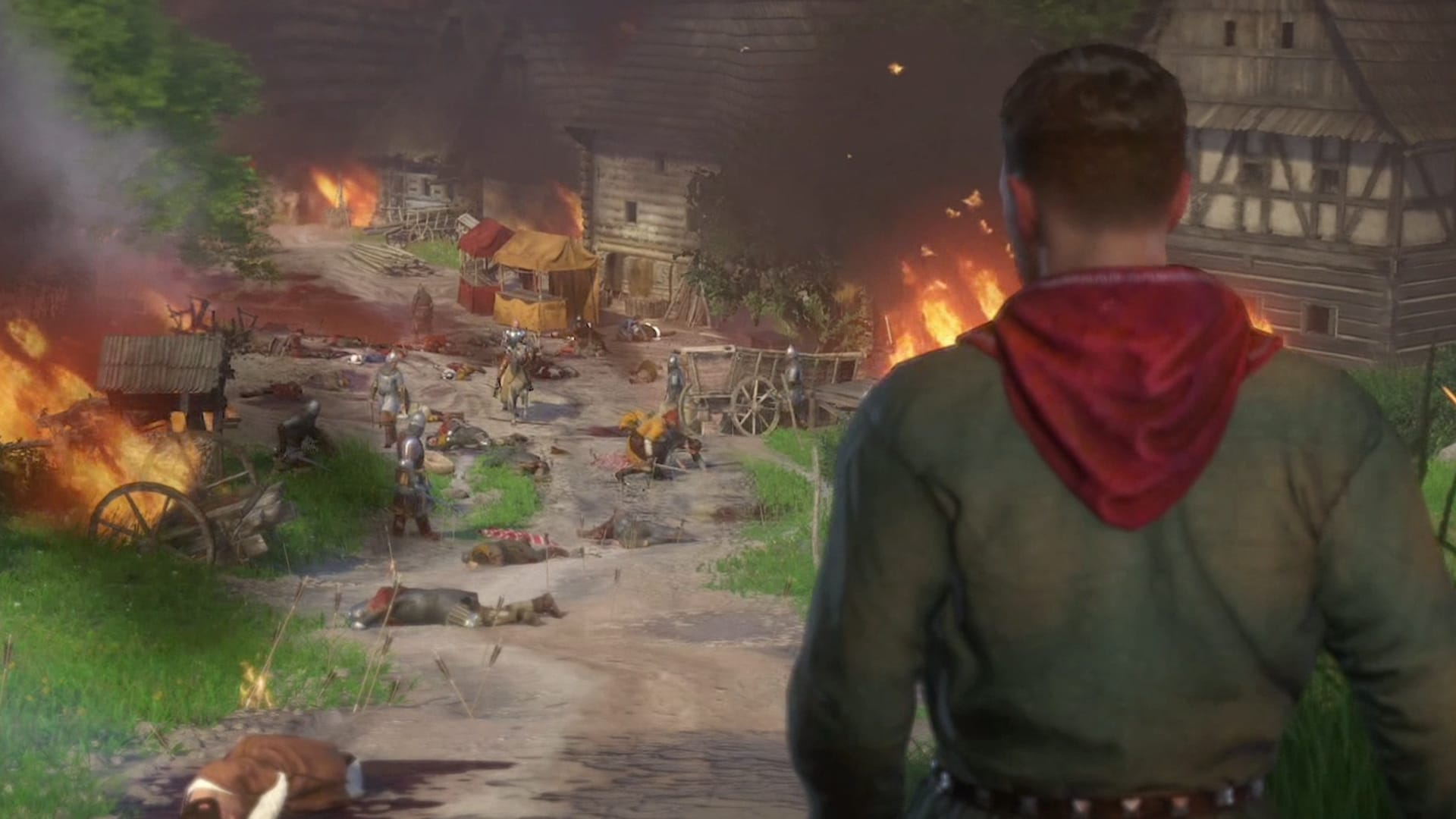
The game doesn't let you be competent in your grief. You stumble, fail, get beaten badly while learning the most basic things. That incompetence mirrors something true about early grief—the disorientation of not knowing how to do life anymore, of discovering how many things you didn't know you didn't know.
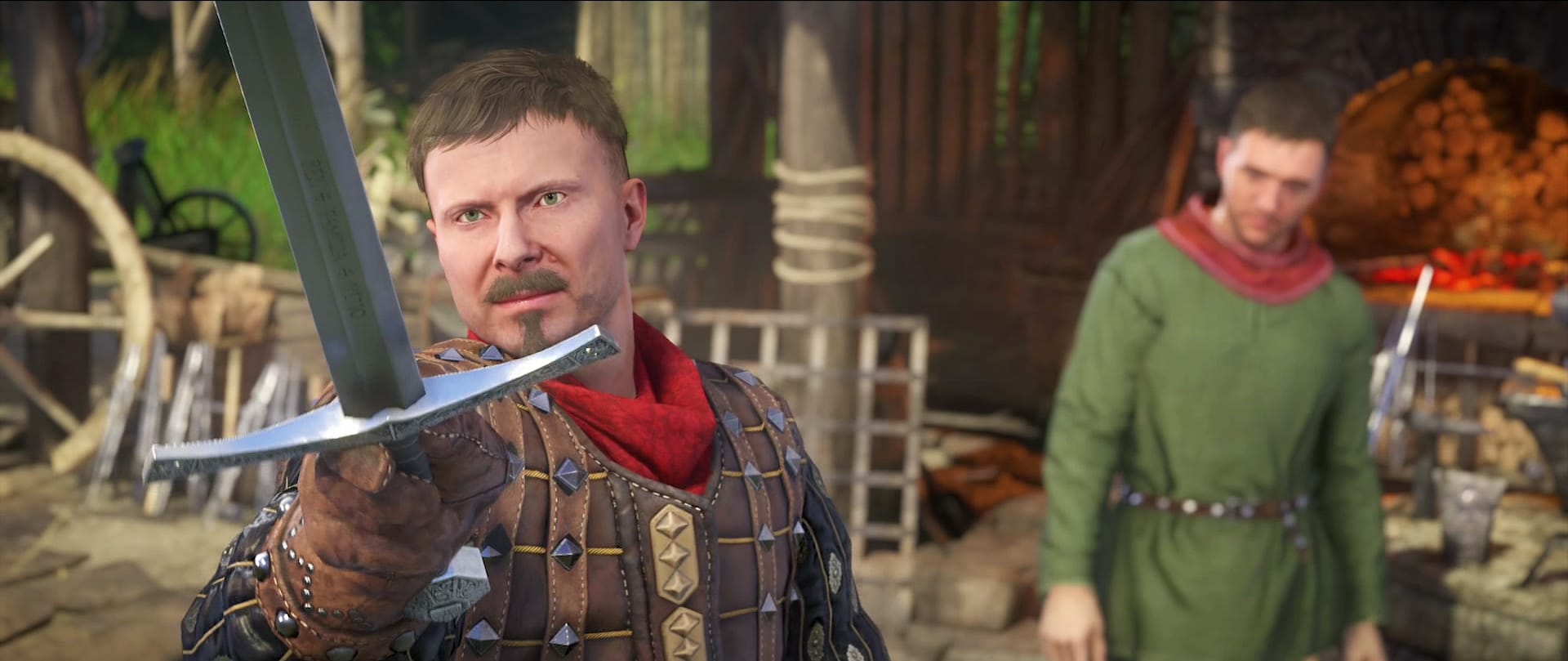
Henry's father was teaching him a trade, a way of being in the world, and that lesson was interrupted. The unfinished sword becomes a tangible symbol of everything left incomplete—lessons not yet learned, conversations not yet had, the person Henry was supposed to become under his father's guidance. Playing it, I could feel that thread of my own grief: figuring out who I am with my mother gone.
Two games, two different threads of the same grief. God of War for the relational work—reaching toward someone who's still here, building a bridge without the person who used to make it easy. Kingdom Come for the solitary work—the messy, hard, stumbling process of learning to be in the world without the person who helped steady you for so long.
Through these games, I could finally name what I was feeling. I could point to Kratos and say: that's the relational grief, the reaching across a gap that didn't used to be there. I could point to Henry and say: that's the becoming grief, having to figure it out when it's hard and messy in the absence of the person you turned to.
For years I thought this way of processing—through games, through characters, through external narrative—was a quirk. A workaround. A detour around the "real" work of emotional processing. But I've come to understand that for my autistic brain, this is the real work. And there's neuroscience behind why.
The Inside is Unclear: Interoception Differences
Interoception is the sense that tells you what's happening inside your body—hunger, fatigue, your heart rate, the physical signatures of emotions. It's how you know you're anxious before you've consciously labeled the feeling as anxiety.
Research consistently shows that autistic people experience interoception differently. A 2024 meta-analysis found that autistic people showed reduced accuracy in detecting their own heartbeat while simultaneously reporting higher confidence in their interoceptive abilities—a mismatch between what's actually happening inside and what we perceive. Other research describes this as "interoceptive confusion"—not necessarily that the signals aren't there, but that they're difficult to accurately perceive, interpret, and integrate.
Dr. Emma Goodall, an autistic researcher, describes three patterns: hyposensitivity (not noticing internal signals unless they're intense), hypersensitivity (perceiving signals quickly and intensely), and poor discrimination (feeling something but being unable to identify what it is). Many of us experience all three in different domains.
This is exactly what I experienced after my mother's death. I knew something large was happening inside me. I could feel the weight of it, the way it colored everything. But when I tried to read the signal directly—to identify what specific emotions I was feeling and what they meant—I found only noise. The internal channel was too unclear.
When you can't clearly read the signal from the inside, external representations become essential. When I watched Kratos struggle to reach his son, I wasn't just observing his experience—I was seeing a visible, concrete externalization of internal states that my brain could actually parse. The murky, undifferentiated "something is happening inside me" became: oh, that's what this is. That's the shape of what I'm experiencing.
No Words for Feelings: The Alexithymia Connection
Alexithymia—literally "no words for emotions"—is a subclinical trait characterized by difficulty identifying, distinguishing, and describing one's emotional states. You might know something is happening emotionally, but struggle to name whether it's sadness, anger, fear, or frustration.
While alexithymia occurs in roughly 10% of the general population, research suggests that approximately 50% of autistic individuals experience clinically significant alexithymia—a striking overlap that has led some researchers to argue that emotional processing difficulties traditionally attributed to autism may actually stem from co-occurring alexithymia.
This is where narrative becomes powerful. Games don't just show emotions—they contextualize them. They provide cause and effect, visible triggers and consequences, character arcs that unfold emotional states over time.
I couldn't name "the specific grief of losing the person who translated between me and my dad." That's too abstract, too internal. But I could watch Kratos and Atreus learn to communicate without Faye, and suddenly I had a framework. The game showed me what that kind of grief looks like—how it manifests in awkward silences, in halting attempts at connection, in the slow work of building a new bridge. Once I could see it externally, I could name it in myself.
Similarly, I couldn't articulate "the disorientation of figuring out who I am without my mother's presence." But I could feel it resonate when Henry stumbled through learning to fight, to survive, to become someone without his father's guidance. The game gave form to something formless.
Finding the Pattern: Systematizing as Primary Mode
Simon Baron-Cohen's research on the "systemizing mechanism" proposes that autistic brains are often calibrated toward pattern recognition—identifying the if-then rules that govern how systems work. This isn't limited to mechanical or technical systems; it applies to any domain with identifiable rules and patterns.
Raw, unmediated emotion doesn't come with a schema. It's high-variance, unpredictable, resistant to the kind of systematic analysis that many autistic brains naturally gravitate toward. But emotion embedded in narrative does have structure: character arcs, cause and effect, recognizable patterns that repeat across stories and can be analyzed, compared, and integrated.
Playing God of War, I was essentially systematizing grief. I was identifying patterns: if a character avoids emotional expression, then their relationships suffer in these specific ways. If someone loses the person who bridged their relationships, then the remaining connections have to find new ground. These patterns became frameworks I could apply to my own experience.
Games offer something particularly valuable here: interactive systematizing. You're not just observing patterns—you're testing them. You make choices, see consequences, replay scenarios, and experiment with different approaches. The emotional content becomes something you can engage with systematically, which may be exactly the mode of engagement your brain is optimized for.
Containment and Control: Managing Overwhelm
Emotion dysregulation is well-documented in autism research. Dr. Carla Mazefsky's work describes how autistic individuals may be "physiologically hyper-aroused" and more reactive to emotional stimuli, with differences in the neural structures involved in emotion regulation. Unmediated emotional content can flood the system in ways that don't happen for neurotypical people.
Grief after forty-three years with someone is not a small thing to process. There were times the weight of it threatened to overwhelm me entirely. But games provided edges. I could pause. I could walk away and return. I could approach Kratos's grief in one session and Henry's in another, metabolizing different aspects at different times.
This isn't avoidance, it's titration, the therapeutic concept of approaching difficult material at a pace that allows for integration rather than overwhelm. Research on Video Game Therapy supports this, describing how games allow people to "externalize what is happening in their minds, eventually distancing themselves from the content of their inner world and seeing it as something external to themselves." The distance isn't a disconnection; it's the buffer that makes processing possible.
Special Interests as Emotional Processing
There's another piece to this: for many autistic people, special interests aren't separate from emotional life; they're central to it.
Research on coping strategies in autism consistently identifies "engaging in special interests" as a primary mechanism for managing stress and emotional distress. This isn't escapism. The deep engagement, the ability to return to something familiar and absorbing, the sense of competence and flow, these provide real regulatory function.
Games have been a special interest for most of my life. When I turned to God of War and Kingdom Come in my grief, I wasn't taking a detour around emotional processing. I was working through the medium my brain knows best, the language it's most fluent in. The analysis, the pattern recognition, the ability to revisit and make meaning through something that genuinely captivates me, that's not a workaround. That's working in my native language.
What This Means in Practice
If you're autistic and you find that games help you process difficult emotions, whether that's grief, anxiety, relationship struggles, or identity questions, you're not doing therapy wrong. You're doing it in a way that fits your neurology.
Some practical implications:
Trust the process. If a game is helping you feel something, understand something, or sit with something difficult, that's real therapeutic work. It doesn't need to look like what works for neurotypical people.
Choose intentionally. Different games offer different things. I found God of War helpful for processing relational grief—learning to reach someone when the person who connected us is gone. Kingdom Come: Deliverance spoke to the solitary work of figuring out who I'm becoming without the people who shaped me. Know what you need, and let that guide your choices.
Name it to yourself. When a game moment hits you, try to articulate what it's reflecting. "Kratos can't tell Atreus he loves him, and that's how I feel with my dad right now." "Henry is stumbling through becoming someone new, and that's where I am too." The translation back to your own experience is part of the work.
Don't rush. Play at your own pace. Pause. Replay. Let things settle. The containment that games offer is a feature, not a limitation.
Let it be for you first. Before games become content or analysis or something to share, let them be a private space for genuine processing. The integration happens in the playing, not just in the writing about it afterward.
Your Native Language
My mother is gone. That fact sits at the center of my life now, reshaping everything around it. I'm learning to exist in a world where she isn't, and I'm learning to know my father without her as the bridge between us. Both of those are ongoing work, not tasks to complete, but ways of living I'm growing into.
In 2018, I played God of War and saw my father and myself reflected back. I understood something about us through that game. I never thought I'd return to it years later, living inside the story rather than observing it—my father and I alone now, trying to find our way to each other.
Games gave me language for that work when my internal channels were too noisy to read. They externalized what my interoception couldn't clarify. They named what my alexithymia left wordless. They offered patterns for a brain that processes through systematizing. They provided containment when the grief threatened to flood.
For a long time, I thought this way of processing was a substitute for "real" emotional work—a detour for a brain that couldn't do it the normal way. I don't believe that anymore. This is how emotional processing works for this kind of mind. Games aren't a translation away from my feelings; they're a translation into a language my brain can actually speak.
If games speak to you in ways other tools don't, trust that. You're not avoiding the work. You're not doing it wrong. You're doing it in your native language.